
Aadhaar Masking Audit Trail: What to Log and How to Prove Compliance
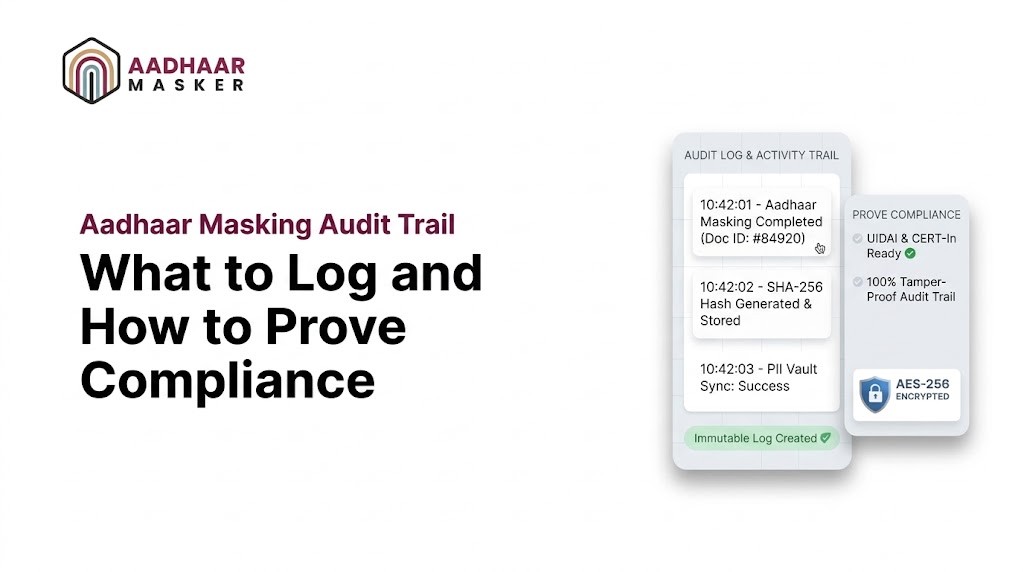
Masking an Aadhaar number is a technical operation. Proving that the masking happened correctly, at the right time, by the right system, on the right document — that is a compliance operation. Regulators and auditors do not evaluate intent; they evaluate evidence. Without a structured Aadhaar masking audit trail, an organization that masks diligently may still be unable to demonstrate compliance when it is asked to.
The Digital Personal Data Protection Act has elevated the documentation requirements that organizations must meet when processing personal data. For Aadhaar specifically, UIDAI's guidelines impose obligations that extend beyond the act of masking itself — they cover how masking is verified, how records are maintained and how access to Aadhaar data is controlled and tracked. An audit trail is the mechanism through which an organization produces proof of compliance on demand.
This blog sets out exactly what a masking audit trail should contain, how records should be retained and structured, and how the trail directly supports DPDP readiness and regulatory defence. It is written for compliance officers, IT architects and operations leaders who need to build or evaluate the evidentiary infrastructure around their masking workflow.
Why an Audit Trail Is Not Optional
Many organizations treat audit logging as a development afterthought — something added to satisfy a checkbox on a compliance questionnaire rather than something designed from the beginning as a core compliance control. This approach fails because it produces logs that are technically present but practically useless when scrutiny arrives.
An audit trail serves four distinct compliance functions:
Demonstrating That Masking Occurred
The most basic function is proof of action. If a document containing an Aadhaar number was processed by your system, the audit trail should confirm that masking was applied before the document was stored or shared. Without this record, there is no way to distinguish between documents that were masked and documents that were not — especially as document volumes grow and original files are overwritten or deleted.
Establishing the Chain of Custody
Aadhaar documents pass through multiple systems — intake channels, masking engines, storage platforms, downstream applications. The audit trail should trace the document through each transition: who received it, what system processed it, what output was produced and where it was sent. Chain of custody documentation is essential when a data incident occurs and investigators need to determine where an unmasked document appeared and how it got there.
Supporting Access Control Verification
UIDAI guidelines require that access to Aadhaar data be limited to authorised individuals and systems. An audit trail that records every access event — who requested a document, from which system, at what time — provides the evidence needed to demonstrate that access controls were enforced. It also creates the basis for detecting anomalous access patterns that may indicate a policy violation or a breach.
Enabling Regulatory Response
When a regulator issues a data audit notice or a data subject exercises their right to inquiry, the organization must respond with specific, verifiable information about how their data was handled. An audit trail that cannot answer specific questions about individual documents or individual access events is not adequate for regulatory response. The trail must be queryable, structured and complete.
What the Aadhaar Masking Audit Trail Must Contain
A complete Aadhaar masking audit trail captures events across four categories: document intake, masking operations, storage and access, and exception handling.
Document Intake Events
Every document containing an Aadhaar number that enters your processing environment should generate an intake record. This record should include:
- *A unique document identifier assigned at intake
- *Timestamp of receipt (date, time, timezone)
- *Source channel (API endpoint, upload portal, email gateway, batch feed)
- *Initiating entity (user ID, system ID or third-party identifier)
- *Document type classification (Aadhaar card, e-Aadhaar PDF, mAadhaar screenshot)
- *Hash of the original document file (for integrity verification)
The document hash is particularly important. It creates a cryptographic fingerprint of the original document that can be used later to verify that the intake record corresponds to the actual file received — and that the file has not been altered since intake was logged.
Masking Operation Events
The masking operation itself is the core compliance event. Each masking event should produce a record containing:
- *Document identifier (linked to the intake record)
- *Timestamp of masking operation
- *Masking engine version and model identifier (for solutions using AI-based detection)
- *Detection confidence score returned by the masking engine
- *Masking outcome: success, partial success or failure
- *Number of Aadhaar instances detected and masked within the document
- *QR code masking status: detected and neutralized, detected but not neutralized, not present
- *Hash of the masked output document
- *Processing latency (time taken to complete masking)
The confidence score and masking outcome together tell the story of each document's processing. A document that was masked with a low confidence score should trigger a review flag in the audit log, creating a record that the organization recognized the lower-certainty processing and took appropriate action.
Storage and Access Events
Once a document has been masked, the audit trail must continue to track what happens to it. Storage and access logging should capture:
- *Location where the masked document is stored (system, bucket, path)
- *Timestamp of storage
- *Retention classification assigned (how long the document will be kept)
- *Every retrieval event: who accessed the masked document, from which system, at what time, for what stated purpose
- *Every sharing event: to which external system or party a masked document was transmitted, when and by whom
- *Deletion events: timestamp, initiating entity and reason code when a document is deleted
Access logging at this level creates the foundation for detecting unauthorized access. If a masked document is retrieved by a system or user that has no business reason to access it, the access log captures the event and enables investigation.
Exception and Failure Events
Masking exceptions — cases where the system returned a low confidence score, could not detect the Aadhaar number, or encountered an error — are among the most compliance-sensitive events in the entire workflow. Exception records should include:
- *Document identifier
- *Exception type (detection failure, partial mask, QR code not masked, processing error)
- *Confidence score at time of exception
- *Routing decision: sent to human review, quarantined, returned to sender
- *If human review was performed: reviewer ID, review timestamp, outcome and disposition
- *Final status of the document after exception handling
Exception logs are auditor-facing records that demonstrate the organization did not simply pass unmasked documents through when the automated system failed. They provide evidence of a functioning exception-handling process — which is itself a compliance requirement under UIDAI guidelines.
Log Retention: How Long and in What Form
Maintaining audit logs for a short period defeats their purpose. A data incident that is discovered twelve months after it occurred requires audit logs that go back twelve months or further. UIDAI guidelines and the DPDP Act do not currently specify an explicit log retention period for masking operations, but regulatory best practice and comparable data protection frameworks suggest that audit logs related to sensitive personal data processing should be retained for a minimum of three to five years.
The Aadhaar data vault rules provide important context here — the retention obligations that apply to Aadhaar reference numbers also inform how long associated processing records should be kept. Organizations that have implemented a data vault should align their audit log retention period with their vault retention policy so that the two records systems tell a coherent story.
Immutability Requirements
Audit logs must be write-once — a log entry that can be altered after the fact provides no evidentiary value. Storing audit logs in a system that also hosts production data creates the risk that a data incident affecting the production environment could also affect the audit record. Best practice is to write audit logs to a separate, immutable storage system: a write-once object store, an append-only database or a dedicated log management platform with tamper-evident controls.
Cryptographic signing of log entries — where each entry is hashed and the hash is stored alongside the entry — provides a mechanism for verifying that log records have not been modified since they were written. This is particularly important for logs that may need to be presented as evidence in a regulatory investigation.
Structured Format for Queryability
Audit logs that exist as unstructured text files cannot be queried efficiently when a regulator asks for the processing history of a specific document or the access history of a specific user. Logs should be stored in a structured format — JSON, structured database records or a log management platform that supports indexed queries — that allows specific records to be retrieved quickly and accurately.
The ability to answer specific audit questions is as important as the existence of the logs themselves. An organization that takes two weeks to produce records in response to a regulator's request because its logs are in unstructured text files stored in a file archive is not in a meaningfully better position than one that has no logs at all.
How the Audit Trail Supports DPDP Readiness
DPDP Act compliance for Aadhaar-processing organizations rests on three pillars: purpose limitation, data minimization and accountability. The audit trail directly supports all three.
Purpose Limitation Evidence
The DPDP Act requires that personal data be processed only for the purpose for which it was collected. An audit trail that records the stated purpose at each access event — why a document was retrieved, what workflow it was used in — creates evidence that access to Aadhaar documents is tied to specific, documented business purposes. Without this, purpose limitation is an assertion, not a demonstrable control.
Data Minimization Evidence
Masking is itself a data minimization control — it reduces the personal data visible in a document to the minimum needed for the business process. The audit trail extends this by showing that masked documents, not original unmasked copies, were used in downstream workflows. If the audit log shows that the original unmasked document was accessed after masking was completed, that access requires justification. The log creates accountability for every access event that goes beyond what data minimization would permit.
Accountability and Demonstrable Compliance
The DPDP Act's accountability principle requires organizations to be able to demonstrate — not just assert — that they have implemented appropriate technical and organizational measures for personal data protection. The audit trail is the primary mechanism for this demonstration. It transforms compliance from a statement of policy into a record of practice.
Organizations preparing for DPDP compliance reviews should treat their audit trail as a first-class compliance artifact — not as an operational log that happens to exist, but as the core document that proves the masking program is functioning as designed.
Integrating the Audit Trail with Your Masking Workflow
An effective audit trail is not assembled manually — it is generated automatically at each stage of the masking workflow by systems that are designed to produce structured log records as a primary output, not an afterthought. The enterprise guide to Aadhaar masking covers implementation architecture in depth, but the audit-specific design principles are worth stating here.
API-Level Logging
Every call to the masking API should be logged at the API gateway level, capturing the request metadata — caller identity, timestamp, document identifier, endpoint called — independently of the application-level logs that the masking engine itself produces. This two-layer logging ensures that the audit trail captures API calls even if the application layer encounters an error that prevents it from completing its own logging.
Event-Driven Architecture for Log Propagation
In a masking workflow, documents flow through multiple systems. Each system should emit a structured event at every significant action — intake, masking, storage, access, deletion. These events should propagate to a central log aggregation system that assembles the complete lifecycle record for each document. Event-driven propagation ensures that no processing stage is logged in isolation; the complete trail is always assembled from the individual events.
Correlation IDs Across Systems
A document's journey through a multi-system workflow will generate log entries in multiple systems. Without a common correlation identifier — a document ID or transaction ID that is consistent across all systems — reconstructing the complete trail for a specific document requires manual matching of records across disparate log sources. Every log entry at every system should carry the document identifier assigned at intake so that the full trail is reconstructable with a single query.
Human Review Queue Logging
Documents routed to a human review queue generate a category of audit records that are especially important for compliance: they document that the organization has a process for handling masking exceptions and that the process was actually followed. Human review logs should capture reviewer identity, review timestamp, the specific action taken (approved, re-masked, quarantined, returned) and any notes attached to the review decision. These records are evidence that the organization's exception-handling process is active and functioning, not just described in a policy document.
Audit Trail Design for Different Deployment Models
The specific implementation of an audit trail depends on the deployment model the organization has chosen for its masking infrastructure. On-premise vs cloud Aadhaar masking deployments have meaningfully different audit architecture requirements.
Cloud Deployments
In a cloud deployment, the masking API is hosted by the vendor and accessed over HTTPS. Audit logging in this model spans two environments: the vendor's platform logs (which record API-level events on the vendor's infrastructure) and the organization's own logs (which record what the organization's systems sent and received). Organizations should request access to vendor-side audit logs as part of their service agreement and should understand what events are captured at the vendor platform level versus what must be captured in their own systems. Compliance accountability cannot be delegated entirely to the vendor — the organization must maintain its own logs for access, storage and downstream handling of masked documents.
On-Premise Deployments
In an on-premise deployment, the organization controls the masking infrastructure and therefore has full responsibility for log generation, storage and retention. This creates greater control but also greater obligation. The organization must implement the full logging stack — API gateway logs, application logs, storage logs, access logs — and must maintain the immutability and integrity of those logs without relying on vendor infrastructure. On-premise deployments should include dedicated log management infrastructure that is isolated from the production masking system.
Hybrid Deployments
Organizations using a hybrid architecture — where some processing occurs on-premise and some in the cloud — face the most complex audit trail challenge. Documents may be partially processed in one environment and completed in another, and the audit trail must span both. Consistent correlation IDs and a centralized log aggregation system that receives events from both environments are essential for maintaining a coherent audit trail across a hybrid architecture.
Common Audit Trail Gaps and How to Close Them
Organizations that review their existing logging infrastructure against the requirements above often discover specific gaps. The most common are:
No QR Code Masking Status in Log Records
Many organizations log whether the Aadhaar number was masked but do not separately record whether the QR code was detected and neutralized. Since the Aadhaar QR code contains the full Aadhaar number and can be scanned to retrieve it, omitting QR masking status from the audit record creates a gap in the compliance evidence. The audit trail should explicitly record QR code handling as a separate field, not assume it is covered by the general masking outcome.
Access Logs That Do Not Capture Purpose
System-level access logs typically record who accessed a resource and when. They do not record why. For DPDP purpose limitation compliance, the "why" is essential. Access logging should require the requesting system or user to supply a purpose code or workflow identifier that is recorded alongside the access event. This design requires coordination between the access control system and the downstream applications that request documents, but without it, purpose limitation evidence cannot be derived from the logs.
Exception Records That Are Incomplete
Exception records are often the weakest part of an audit trail. Organizations that route low-confidence documents to a human review queue frequently have strong logging for the automated processing stage but incomplete records for the review stage — the reviewer's identity, the review timestamp and the final disposition are often not captured in a structured log. Closing this gap requires purpose-built logging in the human review workflow, not just in the automated masking pipeline.
Log Retention That Is Shorter Than the Compliance Window
Organizations that retain logs for 90 days or six months may be compliant with their internal IT retention policies but are exposed for the period after logs are deleted. If a data incident is reported eighteen months after a document was processed, logs that were deleted after six months cannot be produced. Aligning log retention with the organization's data processing compliance window — not with IT cost-optimization preferences — is a governance decision that should be made explicitly and documented.
Logs That Cannot Be Queried Efficiently
An audit trail that takes days to query is not operationally useful for regulatory response. Organizations should test their audit log queryability regularly — specifically testing whether they can answer questions like "show me every access to documents containing Aadhaar data by user X in the past six months" or "show me the complete processing history for document Y" in minutes, not days. If they cannot, the log architecture requires improvement before the audit is requested.
The Audit Trail as a Risk Management Tool
Beyond compliance demonstration, the Aadhaar masking audit trail is a risk management instrument. The patterns visible in a well-structured audit log reveal operational risks that are invisible without systematic logging.
Detecting Masking Accuracy Degradation
A rising rate of low-confidence scores or masking failures in the audit log is an early signal that something has changed in the document population — a new intake channel is producing lower-quality images, a new document format is being submitted that the masking engine was not trained on, or the masking model's performance has drifted. Without the audit trail, accuracy degradation is detected only when a failure is reported; with the trail, it can be detected proactively through trend analysis. This directly connects to measuring Aadhaar masking accuracy as an ongoing operational discipline.
Identifying Unusual Access Patterns
Access to Aadhaar documents should follow predictable patterns determined by the organization's business workflows. An audit trail that captures every access event enables anomaly detection — identifying accesses that occur outside normal business hours, from unusual system locations, in unusually high volumes or for document types the accessor has no business reason to retrieve. These anomalies may indicate a policy violation, a compromised credential or the early stages of a data exfiltration attempt.
Supporting Vendor Accountability
Organizations that use third-party masking vendors need to be able to verify vendor performance claims through their own audit records. If a vendor claims a 99% masking accuracy rate but the organization's audit logs show a significantly higher rate of low-confidence scores and exception events, the discrepancy is evidence that the vendor's performance claims require scrutiny. The audit trail gives the organization independent verification of what is actually happening in the masking workflow, independent of what the vendor reports.
Preparing for a Regulatory Audit
When a data authority or regulator requests an audit of Aadhaar data handling, the organization's response capability depends entirely on the quality of its audit trail. The following preparation steps should be completed before an audit request arrives — not in response to one.
Map the Document Lifecycle
Document every system through which an Aadhaar-containing document passes, from intake to deletion. Verify that each transition between systems generates an audit record and that the records are linked by a consistent correlation identifier. Identify any transition points that are not currently logged and close those gaps.
Test Queryability Against Likely Audit Questions
Anticipate the specific questions a regulator would ask — "how many Aadhaar documents were processed in the last year?", "show the complete processing history for this document", "who accessed Aadhaar documents from this intake channel in this date range?" — and test whether the audit trail can answer each question accurately and quickly. Document the query procedures so that they can be executed by compliance staff without requiring engineering support during an audit.
Verify Log Integrity
Run periodic integrity checks on the audit log store — verifying that log entries have not been modified since they were written, that the store is functioning as intended and that retention policies are being applied correctly. Log integrity failures discovered during an audit are significantly more damaging than gaps that were identified and addressed proactively.
Document the Audit Trail Architecture
Maintain written documentation of the audit trail architecture: what is logged, by which system, in what format, retained for how long, stored where and accessed by whom. This documentation is itself an audit artifact — it demonstrates that the organization has a designed, governed audit trail rather than an ad hoc collection of system logs.
Connecting the Audit Trail to the Broader Compliance Program
The Aadhaar masking audit trail does not exist in isolation. It is one component of a broader compliance infrastructure that includes masking accuracy controls, access management policies, data retention governance and incident response procedures. The audit trail links these components by providing the evidentiary record that proves each control is functioning.
Organizations that have invested in Aadhaar masking best practices for their sector — whether BFSI, fintech or NBFCs — should treat the audit trail as the accountability layer that makes all other controls verifiable. Without it, controls that exist in policy may not exist in practice, and the difference between the two is what auditors and regulators evaluate.
The regulatory checklist for Aadhaar data masking provides a useful framework for reviewing whether the organization's overall compliance posture is complete. The audit trail is a cross-cutting requirement that appears across multiple items on that checklist — it is not a single checklist item but the evidence base that makes many other items demonstrable.
Organizations that are also managing Aadhaar data as part of loan origination workflows, HR onboarding processes or staffing and gig platform operations will find that the audit trail requirements described here apply consistently across use cases. The document types and workflows differ; the fundamental logging requirements do not.
Conclusion
A masking program that cannot prove compliance is not a compliance program — it is an operational process that happens to align with compliance requirements until someone asks for evidence. The Aadhaar masking audit trail is the difference between these two states.
Building a complete audit trail means logging intake events, masking operations, storage and access events and exception handling — each with sufficient detail to answer specific regulatory questions. It means storing logs in immutable, queryable formats and retaining them for a period that covers the organization's compliance exposure window. It means testing the trail's queryability before an audit arrives, not during one.
Organizations that have implemented structured, complete audit trails around their masking workflow are in a fundamentally different regulatory position from those that have not. They can respond to data subject inquiries quickly and accurately. They can demonstrate to regulators that their masking controls are functioning. They can detect compliance gaps from log analysis before those gaps become incidents. And they can show, with evidence, that they took UIDAI guidelines and DPDP requirements seriously — not just in policy, but in practice.
Log Everything. Prove Compliance. Build Confidence.
Our Aadhaar masking platform generates a complete, structured audit trail for every document processed — intake records, masking outcomes, confidence scores, QR code handling status and access logs — stored in an immutable, queryable format ready for regulatory response. Every processing event is logged automatically, with no manual configuration required, so your compliance evidence grows with every document your system handles.
- *Structured audit logs with per-document masking and QR code status
- *Immutable log storage with cryptographic integrity verification
- *Exception and human review tracking built into the workflow
- *Query-ready log architecture for rapid regulatory response
Request a Personalized Demo to see the audit trail in action and understand how it supports your DPDP and UIDAI compliance obligations.




Top Posts
- Why an Audit Trail Is Not Optional
- What the Aadhaar Masking Audit Trail Must Contain
- Log Retention: How Long and in What Form
- How the Audit Trail Supports DPDP Readiness
- Integrating the Audit Trail with Your Masking Workflow
- Audit Trail Design for Different Deployment Models
- Common Audit Trail Gaps and How to Close Them
- The Audit Trail as a Risk Management Tool
- Preparing for a Regulatory Audit
- Connecting the Audit Trail to the Broader Compliance Program
- Conclusion