
Aadhaar Masking in Loan Origination: Protecting Borrower Documents End to End
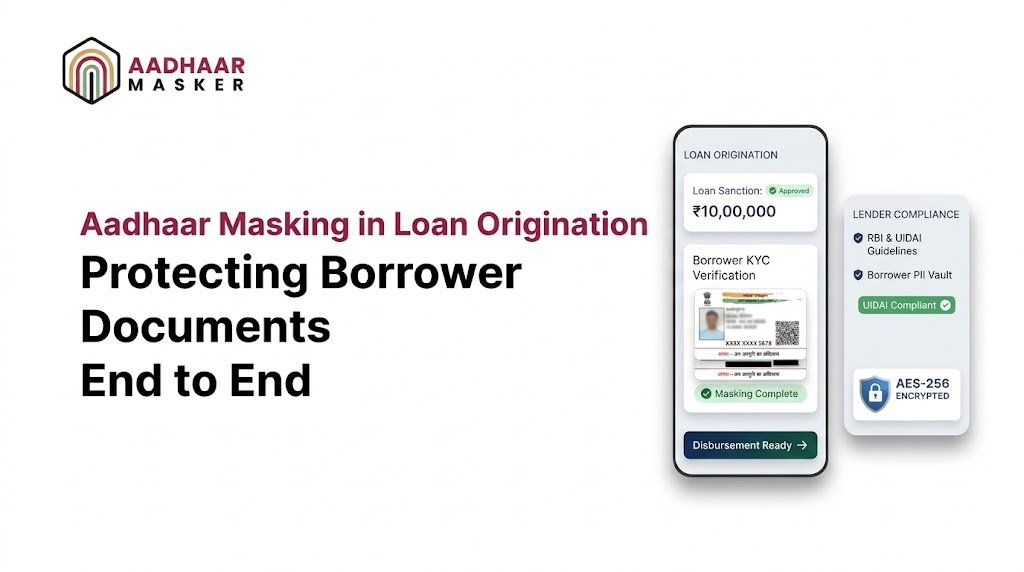
Loan origination is one of the most document-intensive processes in financial services. Every borrower submits an Aadhaar copy as part of KYC, and that document immediately begins moving — across credit assessment teams, bureau check vendors, legal teams, DSA partners, and loan management systems. By the time a loan is disbursed, a single borrower's Aadhaar copy may have passed through five or more systems, each holding a copy that could represent a compliance or security liability.
Aadhaar masking loan origination is the practice of applying automated masking to borrower Aadhaar documents at the point they enter the loan origination system, so that only masked copies travel through the workflow from that point forward. An Aadhaar Masking API integrated into a loan origination system (LOS) handles this automatically — the borrower submits the original, and the system stores and routes only the masked version.
This blog explains where in the loan origination lifecycle Aadhaar documents are most exposed, how automated masking addresses those exposures, and what lenders and NBFCs should look for when building a compliant, end-to-end document protection workflow. For the broader regulatory framework governing this area, see the BFSI and NBFC best practices guide.
Why Borrower Aadhaar Data Is Especially Vulnerable in Loan Origination
The loan origination process creates structural conditions that amplify Aadhaar data risk. Unlike a one-time onboarding event, loan origination involves multiple handoffs between internal teams and external parties, each of which creates a new copy or access point for borrower identity documents.
Multiple Parties Handle the Same Document
A typical personal loan application in India may involve the borrower, a direct sales agent (DSA) or sourcing partner, a credit operations team, an underwriting analyst, a bureau check vendor, a legal or technical team for property loans, a loan management system (LMS), and a document archiving system. Each party that receives an unmasked Aadhaar copy represents an additional exposure point. A data breach at any one of these touchpoints can compromise the borrower's full Aadhaar details.
DSA and Channel Partner Networks
Banks and NBFCs often originate loans through large networks of DSAs and channel partners who collect documents directly from borrowers. These partners use their own devices and often email or WhatsApp document copies to the lender's operations team. This is one of the highest-risk points in the origination chain — unmasked Aadhaar copies travel through third-party email systems and messaging apps with no encryption or access control.
Bureau and Third-Party Check Vendors
Credit bureau checks, fraud checks, and field verification agencies all require identity document submission. When lenders send unmasked Aadhaar copies to these vendors, they transfer liability as well as data. A breach at a bureau or verification vendor can expose thousands of borrower Aadhaar numbers that originated with the lender.
Long Document Retention Periods
Loan documents are typically retained for seven to ten years after loan closure. This means unmasked Aadhaar copies stored during origination remain as live data liabilities for a decade or more. A vulnerability discovered years after origination can still expose borrower data collected at the time of the loan application.
The Loan Origination Lifecycle: Where Masking Should Be Applied
Effective aadhaar masking loan origination is not a single step — it is a series of controls applied at each stage where Aadhaar data enters or moves through the origination workflow.
Stage 1: Application Intake
Whether a borrower applies through a digital portal, a mobile app, a DSA, or a branch, the Aadhaar document should be masked immediately upon upload or receipt. If the application is submitted through a DSA's device, masking should happen before the document is transmitted to the lender's system. An Aadhaar Masking API embedded in the application intake layer handles this automatically — the origination system never receives an unmasked copy.
Stage 2: Credit Operations and Underwriting
Credit analysts and underwriters need to verify borrower identity, but they do not need to see the full Aadhaar number to do so. A masked copy showing the borrower's name, address, photograph, and last four Aadhaar digits is sufficient for identity confirmation at this stage. Providing only masked documents to credit operations teams limits insider access to full Aadhaar numbers without disrupting the underwriting workflow.
Stage 3: Bureau and Verification Vendor Submission
Credit bureau submissions and field verification requests typically use a borrower's name, date of birth, and address — not the full Aadhaar number — for matching. Where Aadhaar documents are submitted to verification vendors, masked copies should be the default. If a specific process genuinely requires the full number, access should be controlled and logged, not provided as a matter of routine.
Stage 4: Legal and Technical Verification
For secured loans — home loans, loan against property, vehicle loans — documents are reviewed by legal and technical teams or empanelled advocates. These reviews are focused on property or asset verification, not borrower identity. Masked Aadhaar copies are fully sufficient for the identity component of these reviews.
Stage 5: Loan Disbursement and Account Creation
At disbursement, the borrower's account is created in the core banking system or LMS. Aadhaar-linked fields in these systems should reference a token or the last four digits rather than storing the full number. The disbursement process does not require unmasked Aadhaar data, and the LMS record should reflect a masked document reference from the point of creation.
Stage 6: Document Archiving and Loan File Storage
Post-disbursement, the complete loan file — including KYC documents — is archived for the regulatory retention period. Every Aadhaar document in the archived loan file should be a masked version. Retroactive masking of existing loan files is also a necessary exercise for lenders who have accumulated years of unmasked Aadhaar copies in their document management systems.
How an Aadhaar Masking API Works in a Loan Origination System
A well-integrated Aadhaar Masking API operates invisibly within the loan origination workflow. The borrower and the operations team experience no additional steps — masking happens automatically as part of the document ingestion process.
Step 1: Document Submission
The borrower uploads an Aadhaar document through the lender's application portal or mobile app, or a DSA uploads it on the borrower's behalf. The document may be a PDF, a JPG photograph, or a scanned image in any standard format.
Step 2: Aadhaar Document Detection
The API uses AI to confirm that the uploaded document is an Aadhaar card. This prevents masking errors on non-Aadhaar documents and flags documents that may have been incorrectly categorized for manual review.
Step 3: OCR and Number Extraction
Optical Character Recognition reads the 12-digit Aadhaar number from the document. The OCR engine is trained to handle low-quality mobile photographs, skewed scans, shadow-affected images, and documents with varied layouts across different Aadhaar card generations.
Step 4: Masking Applied
The first eight digits of the Aadhaar number are replaced with Xs or asterisks, leaving the last four digits visible. If the document contains an embedded QR code — which stores personal data including the full Aadhaar number — the API masks the QR code as well, replacing it with a non-functional placeholder. This is a step many lenders overlook, creating a gap where the QR code remains as a readable source of unmasked data even after the printed number is masked.
Step 5: Masked Document Returned to LOS
The masked document is returned to the loan origination system within seconds. The LOS stores and routes this masked version to all downstream workflows. The original unmasked document is not retained unless there is a documented, access-controlled exception process.
Step 6: Audit Log Created
The API records a log entry confirming the document ID, masking timestamp, and outcome. This log supports compliance audits and provides evidence of systematic data protection practices when regulators or auditors review the lender's KYC document handling procedures.
Regulatory Requirements Driving Aadhaar Masking in Lending
Lenders operating in India face a converging set of regulatory requirements that make aadhaar masking loan origination a compliance necessity, not just a best practice.
UIDAI Guidelines
The Unique Identification Authority of India has mandated that requesting entities — organizations that collect Aadhaar as proof of identity — must store only masked Aadhaar copies and implement appropriate security safeguards for Aadhaar data. Banks, NBFCs, and fintech lenders collecting Aadhaar as KYC documentation fall within this mandate.
RBI KYC Master Directions
The Reserve Bank of India's KYC Master Directions require regulated entities to implement adequate data security measures for customer identity documents. These directions reinforce the UIDAI mandate and make data protection for Aadhaar documents a core component of KYC compliance for all RBI-regulated lenders.
Digital Personal Data Protection Act
The DPDP Act introduces purpose limitation, data minimization, and storage limitation requirements that directly affect how lenders handle borrower Aadhaar data. Storing full Aadhaar copies beyond the minimum period required, or sharing unmasked documents with vendors without explicit justification, is inconsistent with DPDP obligations. Masking borrower Aadhaar documents at origination is a concrete technical step that operationalizes these principles.
NBFC Regulatory Framework
Non-banking financial companies are subject to RBI oversight and must comply with KYC and data protection requirements equivalent to those applied to banks. For NBFCs operating in digital lending, personal loans, or MSME lending — segments with high document volumes — automated masking is an essential control for maintaining regulatory compliance at scale. Lenders looking to benchmark their implementation against industry norms should review BFSI and NBFC best practices for Aadhaar masking.
Risks Lenders Face Without End-to-End Aadhaar Masking
Financial institutions that have not implemented systematic aadhaar masking loan origination controls face concrete operational and regulatory risks.
Data Breach at DSA or Channel Partner Level
DSA networks are the weakest link in most lenders' data security chains. Unmasked Aadhaar documents collected by DSAs and transmitted informally can be intercepted, copied, or misused with minimal technical effort. A single compromised DSA can expose thousands of borrower Aadhaar records that were never formally within the lender's controlled infrastructure.
Vendor-Side Breach Liability
When lenders share unmasked Aadhaar copies with bureau check vendors, field verification agencies, or legal empanelment firms, they transfer data risk without transferring liability. A breach at a third-party vendor that received unmasked documents from the lender creates reputational and regulatory exposure for the lender, not just the vendor.
Insider Threat
Loan operations teams, underwriters, and collections staff who have access to unmasked Aadhaar documents represent an insider threat vector. Limiting access to masked copies — with full numbers available only through an audited exception process — significantly reduces the risk of internal misuse.
Regulatory Penalty and Audit Findings
UIDAI and RBI audits of KYC document handling practices are increasingly focused on data minimization and security controls. An audit finding that a lender routinely stores and shares unmasked Aadhaar copies without adequate justification can result in regulatory action and reputational damage that outweighs the cost of implementing masking.
Borrower Trust and Brand Risk
Borrowers who learn that their Aadhaar data was shared broadly across DSA networks and vendor ecosystems without masking lose confidence in the lender's data practices. In a competitive lending market where digital-first NBFCs and fintech lenders compete aggressively on customer experience, data protection is increasingly part of the brand promise.
What a Compliant Loan Origination Masking Setup Looks Like
Building an effective aadhaar masking loan origination setup requires aligning technology, process, and governance. Here is what a well-designed implementation includes.
API Integration at Document Intake
The Aadhaar Masking API is integrated into the loan origination system's document upload layer. Every Aadhaar document is masked before it is stored or routed to any downstream workflow. No unmasked Aadhaar copy enters the LOS storage layer.
DSA Portal Masking
DSA-facing portals or mobile apps used for document collection incorporate the masking API at the point of upload, so that the document is masked before it is transmitted to the lender's system. DSAs never need access to unmasked Aadhaar data beyond the initial collection moment.
Vendor Document Sharing Controls
When documents are shared with bureau check vendors, field verification agencies, or legal teams, the document management system automatically provides masked copies. Access to unmasked versions requires a formal exception request with documented justification, reviewed by a data protection officer or equivalent role.
Retroactive Masking for Legacy Loan Files
For lenders with existing loan portfolios, a bulk masking exercise identifies and masks all unmasked Aadhaar documents in archived loan files. This is a one-time remediation that brings the document archive into compliance with UIDAI guidelines and DPDP Act requirements.
Audit Logging and Compliance Reporting
Every masking event is logged with a timestamp, document reference, and outcome. These logs are available for compliance review and regulatory audit, providing evidence that the lender has implemented systematic masking across its origination workflow.
QR Code Masking
Aadhaar QR codes contain embedded personal data that remains readable even after the printed number is masked. A complete masking solution masks both the printed number and the QR code, eliminating the gap that many lenders leave open by masking only the visible digits.
Key Features to Look for in an Aadhaar Masking Solution for Lending
When evaluating a masking solution for loan origination, lenders should prioritize capabilities that match the operational reality of high-volume, multi-channel document ingestion.
High OCR Accuracy Across Document Quality Levels
Loan documents arrive as mobile photographs, branch scans, and digitally uploaded files across a wide range of quality levels. The masking solution must reliably detect and mask Aadhaar numbers in all of these formats, including low-resolution images and documents with glare or shadow artifacts.
QR Code Detection and Masking
A lending-grade masking solution must address the QR code alongside the printed number. This is non-negotiable for full compliance with UIDAI data protection requirements.
REST API for LOS Integration
The API should integrate with standard loan origination platforms and document management systems via REST, with clear documentation, sandbox access, and well-defined error handling. Integration timelines should be measured in days, not months.
Bulk Masking for Legacy File Remediation
Lenders with large legacy document archives need bulk processing capability that can handle thousands of files simultaneously. The solution should support scheduled batch jobs as well as real-time API calls.
Deployment Flexibility
Some lenders — particularly larger banks and NBFCs — require on-premise deployment to keep borrower data within their own infrastructure. Others prefer cloud deployment for scalability and reduced maintenance overhead. The solution should support both models without compromising on accuracy or performance.
Comprehensive Audit Trail
Regulatory compliance requires documented evidence of masking activity. The solution must maintain a detailed audit log that supports both internal compliance reviews and external regulatory audits.
Best Practices for Lenders Implementing Aadhaar Masking
Technology implementation is the foundation, but effective aadhaar masking loan origination requires operational practices that reinforce the technical controls.
- *Mask at the point of entry — before any Aadhaar document is stored, routed, or shared, not after the fact.
- *Extend masking to DSA and channel partner intake channels, not only to direct digital applications.
- *Share only masked documents with all third-party vendors by default, with exceptions requiring documented justification.
- *Conduct a retroactive audit of existing loan file archives to identify and remediate unmasked Aadhaar copies.
- *Define and document a data retention policy for borrower KYC documents that aligns with DPDP Act storage limitation requirements.
- *Train operations staff, credit teams, and DSA onboarding managers on Aadhaar data handling requirements and the role of masking in compliance.
- *Review vendor contracts to confirm that third parties handling borrower documents apply equivalent data protection standards.
- *Maintain and periodically review the masking audit log as part of the lender's broader data governance program.
Conclusion
Loan origination is one of the highest-risk environments for borrower Aadhaar data. Documents collected at intake travel through DSA networks, credit operations, bureau vendors, legal teams, and long-term archiving systems — each step creating new exposure. Without systematic aadhaar masking loan origination controls, lenders accumulate a growing liability across their document workflows that represents both a security risk and a regulatory compliance gap.
An Aadhaar Masking API integrated into the loan origination system addresses this end to end. Masking applied at intake means no unmasked Aadhaar copy ever enters the document management layer. Downstream workflows — underwriting, bureau checks, legal review, archiving — receive only masked copies by default. The result is a loan origination process that is leaner in data risk, stronger in borrower trust, and aligned with UIDAI, RBI, and DPDP Act requirements.
Lenders who build masking into their origination workflows today will be better positioned as data protection enforcement matures — and better prepared to demonstrate to regulators that borrower identity data is handled with the care it requires.
Protect Borrower Data. Strengthen Lending Compliance.
Automate Aadhaar masking across your entire loan origination workflow with our AI-powered Aadhaar Masking Solution. Integrate with your LOS, DSA portals, and document management system using our Aadhaar Masking API and ensure every borrower document is protected from intake to archive.
- *End-to-end masking from application intake to long-term storage
- *QR code masking alongside printed number masking
- *Bulk masking for legacy loan file remediation
- *UIDAI, RBI, and DPDP Act compliant controls
Request a Personalized Demo and see how your lending team can protect borrower Aadhaar data across every stage of the origination lifecycle.

Top Posts
- Why Borrower Aadhaar Data Is Especially Vulnerable in Loan Origination
- The Loan Origination Lifecycle: Where Masking Should Be Applied
- How an Aadhaar Masking API Works in a Loan Origination System
- Regulatory Requirements Driving Aadhaar Masking in Lending
- Risks Lenders Face Without End-to-End Aadhaar Masking
- What a Compliant Loan Origination Masking Setup Looks Like
- Key Features to Look for in an Aadhaar Masking Solution for Lending
- Best Practices for Lenders Implementing Aadhaar Masking
- Conclusion