
Aadhaar Masking for HR: Protecting Employee IDs During Hiring and Background Checks
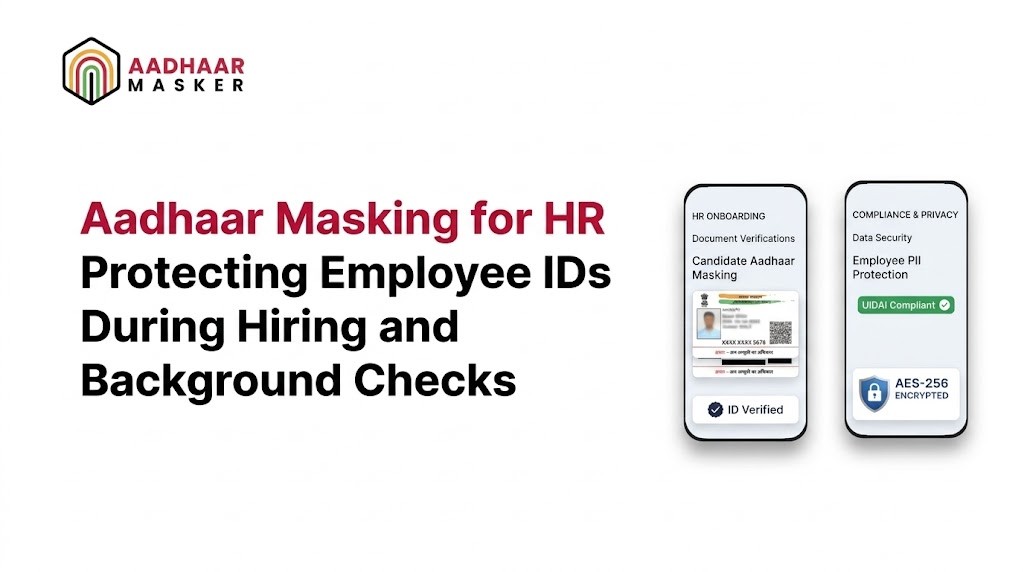
Every year, HR teams across India collect hundreds — sometimes thousands — of Aadhaar copies from job applicants and new hires. These documents pass through recruitment portals, background verification agencies, payroll software, and HRMS systems before they are archived. At each step, sensitive Aadhaar data is exposed to more people than necessary, increasing the risk of a data breach or a compliance violation under the DPDP Act.
Aadhaar masking for HR is a straightforward solution to this growing problem. By automatically hiding the first eight digits of an Aadhaar number and retaining only the last four, HR departments can confirm identity without storing or sharing full Aadhaar details. An aadhar masking solution built specifically for HR workflows integrates directly into recruitment and onboarding pipelines, while an Aadhaar Masking API connects seamlessly with existing HRMS, ATS, and background check platforms.
This blog explains what Aadhaar masking for HR means, where it applies during the hiring lifecycle, how the masking process works, and what HR teams should look for in a reliable solution.
Why HR Teams Handle More Aadhaar Data Than Almost Any Other Department
HR is one of the most document-intensive functions in any organization. During recruitment and onboarding alone, HR teams typically collect Aadhaar copies for:
- *Identity verification during the offer stage
- *Background checks conducted by third-party agencies
- *Address proof submission for employee records
- *EPF and ESIC registration
- *Tax declaration and Form 12BB submission
- *Bank account verification for salary disbursement
- *Employee onboarding documentation in HRMS platforms
Each of these touchpoints represents a moment where unmasked Aadhaar data can be seen, stored, emailed, or mishandled. When documents are shared with background verification vendors, payroll processors, or statutory compliance teams, the exposure multiplies further.
Without a structured aadhaar masking for hr process, organizations risk holding unmasked Aadhaar copies across multiple systems — a clear liability under the UIDAI guidelines and the emerging Digital Personal Data Protection (DPDP) Act framework.
What Is Aadhaar Masking and How Does It Apply to HR?
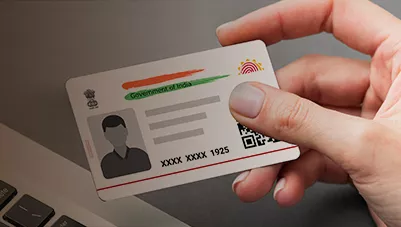
Aadhaar masking is the process of concealing the first eight digits of a 12-digit Aadhaar number in a document, replacing them with Xs or asterisks, while leaving the last four digits visible. The resulting masked document can still confirm identity but cannot be used to access Aadhaar-linked services fraudulently.
In an HR context, masking applies to every Aadhaar document that an employee or candidate submits. Instead of storing a full Aadhaar copy, the HR team stores a masked version that retains only what is needed for verification purposes.
A modern aadhar masking solution uses AI-powered OCR to automatically detect the Aadhaar number within a document — whether it is a clear scan, a mobile photo, or a PDF — and applies the mask without any manual editing. The process takes seconds and produces a clean, compliant document ready for storage or sharing.
If you want a foundational overview of how Aadhaar masking works across document types, read our Complete Guide to Aadhaar Masking for Privacy, Compliance and Secure Document Sharing.
Where Aadhaar Masking Fits in the Hiring Lifecycle
Aadhaar documents are collected and used at multiple stages during recruitment and onboarding. Here is where masking should be applied at each stage.
Stage 1: Application and Screening
Some organizations collect government ID proof during the initial application stage. If Aadhaar is accepted as proof, the document should be masked immediately upon upload in the applicant tracking system (ATS). The recruiting team needs to confirm that the candidate has submitted a valid document — they do not need the full Aadhaar number to do so.
Stage 2: Background Verification
Background check agencies are among the largest third-party recipients of employee Aadhaar copies. When HR teams share documents with BGV vendors, they often send unmasked copies because the verification process seems to require full identity details.
In practice, background verification can be completed with a masked Aadhaar copy in most cases. The BGV agency confirms that the document belongs to the candidate; they do not need to store or process the full number. Using an Aadhaar Masking API to automatically mask documents before sending them to BGV partners significantly reduces data exposure without disrupting the verification workflow.
Stage 3: Offer and Pre-Joining Documentation
During the offer stage, HR teams collect documents for statutory registrations, bank account linking, and internal records. Each document should be masked at the point of collection — either through a self-service digital onboarding portal or via an automated masking step built into the HR platform.
Stage 4: Employee Onboarding in HRMS
When the employee joins, their documents are uploaded to the HRMS for record-keeping. If the HRMS integration includes an Aadhaar Masking API, masking can happen automatically during the upload — the employee submits the original, and the system stores only the masked version.
Stage 5: Statutory Compliance and Payroll
For EPF, ESIC, and income tax filings, HR and payroll teams reference Aadhaar numbers. These processes typically require only the last four digits or use a token-based reference rather than the full number. Masked copies are sufficient for most compliance workflows, and full numbers should only be accessed when absolutely required through a controlled process.
Stage 6: Document Archiving
Employee records are retained for years after an employee leaves. Long-term storage of unmasked Aadhaar copies creates significant liability. Masking all archived Aadhaar documents ensures that historical records comply with data minimization principles under the DPDP Act.
How an Aadhaar Masking API Works Inside HR Systems
An Aadhaar Masking API is a REST-based service that HR platforms, HRMS systems, ATS tools, and background check portals can call programmatically to mask Aadhaar documents in real time. Here is how the typical workflow operates.
Step 1: Document Upload
The candidate or employee uploads their Aadhaar document through an HR portal, mobile app, or self-service kiosk. The document may be a PDF, a JPG scan, or a mobile photograph.
Step 2: AI Document Detection
The Aadhaar Masking API uses AI to verify that the uploaded document is an Aadhaar card and not another ID type. This prevents unnecessary masking of unrelated documents and flags non-Aadhaar uploads for manual review.
Step 3: OCR Extracts the Aadhaar Number
Optical Character Recognition (OCR) technology reads the Aadhaar number from the document, even if the document is slightly skewed, has shadows, or is a low-quality scan.
Step 4: Automatic Masking
The API applies the mask to the first eight digits of the Aadhaar number, replacing them with Xs while preserving the last four digits. If the document contains a QR code with embedded Aadhaar data, the API can mask that as well — an important step that many organizations overlook.
Step 5: Masked Document Returned
The masked document is returned to the HR system within seconds. The HRMS stores only this masked version. The original unmasked document is not retained unless there is an explicit, documented reason to do so.
For a detailed walkthrough of API integration steps, response formats, and error handling, refer to our Aadhaar Masking API Integration Guide.
DPDP Act Compliance and Aadhaar Masking for HR
The Digital Personal Data Protection Act introduces several obligations that directly affect how HR teams handle employee and candidate data. Key provisions relevant to Aadhaar documents include:
Purpose Limitation
Personal data should be collected only for a specific, lawful purpose and not used beyond that purpose. Collecting full Aadhaar copies when a masked copy suffices for identity confirmation violates this principle.
Data Minimization
Organizations should collect only the minimum data necessary. Storing unmasked Aadhaar documents when only the last four digits are needed for most HR processes is inconsistent with data minimization requirements.
Storage Limitation
Personal data should not be retained beyond the period required for its stated purpose. Long-term archival of unmasked Aadhaar copies without a clear retention justification creates compliance risk.
Security Safeguards
Organizations must implement appropriate technical safeguards to protect personal data. Automated aadhaar masking for hr workflows are a concrete technical control that demonstrates proactive compliance with this requirement.
Being DPDP-ready is not a one-time checkbox — it requires embedding privacy-by-design practices into HR workflows. Aadhaar masking is one of the most practical steps HR teams can take to operationalize that commitment.
Risks of Not Masking Aadhaar in HR Workflows
HR teams that continue to store and share unmasked Aadhaar copies face several concrete risks.
Data Breach Exposure
A compromised HRMS or email account can expose hundreds or thousands of employee Aadhaar numbers. Masked documents dramatically reduce the value of such a breach to an attacker.
Vendor Risk
Background verification agencies, payroll processors, and recruitment platforms each represent a point where unmasked data can be mishandled. Sharing only masked documents limits the damage if a vendor's systems are compromised.
Regulatory Penalties
Under the DPDP Act, organizations can face significant penalties for failing to implement adequate data protection measures. Unmasked Aadhaar storage without documented justification is a clear gap that regulators may target during audits.
Employee Trust
Employees who learn that their Aadhaar copies are stored without masking or shared freely with vendors lose trust in their employer's data practices. This affects employer brand and employee satisfaction, particularly among privacy-conscious candidates.
What to Look for in an Aadhaar Masking Solution for HR
Not all masking tools are designed to handle the volume and variety of documents that HR teams process. When evaluating an aadhar masking solution for HR use cases, look for the following capabilities.
AI-Powered OCR
The solution should accurately detect Aadhaar numbers even in low-quality scans, mobile photographs, and documents with non-standard layouts.
QR Code Masking
Aadhaar cards contain QR codes with embedded personal data. The masking solution should handle QR code masking alongside number masking to ensure complete document protection.
Bulk Processing
HR teams onboarding large batches of employees — particularly during campus hiring or high-volume recruitment cycles — need bulk masking capability that can handle hundreds of documents simultaneously.
REST API for HRMS Integration
The Aadhaar Masking API should integrate easily with existing HRMS, ATS, and document management systems without requiring significant development effort.
Support for Multiple File Types
Documents arrive as PDFs, JPGs, PNGs, and TIFFs. The solution should handle all common formats without manual conversion.
Audit Logging
Compliance requires evidence. The solution should maintain logs of which documents were masked, when, and by whom — supporting audit readiness under DPDP and UIDAI guidelines.
Cloud and On-Premise Deployment
Some organizations prefer cloud-based deployment for scalability, while others require on-premise deployment to keep sensitive data within their infrastructure. A flexible solution supports both models.
High Accuracy Rate
Missed masking — where the Aadhaar number is not detected and not masked — is as serious a risk as incorrect masking. Look for solutions with documented accuracy rates and clear error-handling behavior.
Best Practices for HR Teams Implementing Aadhaar Masking
Technology alone is not enough. HR teams should pair an automated aadhar masking solution with clear operational practices.
- *Mask Aadhaar documents at the point of upload, before they enter any storage or workflow system.
- *Define a clear data retention policy for employee identity documents, including masked copies.
- *Restrict access to original unmasked documents to the minimum number of authorized personnel.
- *Share only masked documents with BGV agencies, payroll vendors, and compliance teams.
- *Audit existing HRMS records to identify and mask any unmasked Aadhaar copies currently stored.
- *Train HR staff and recruitment coordinators on why masking matters and how to use the masking tool.
- *Document the masking process as part of the organization's data protection practices for regulatory purposes.
- *Periodically review vendor contracts to confirm that BGV and payroll partners also apply appropriate data protection practices.
Conclusion
HR teams handle Aadhaar data at every stage of the hiring lifecycle — from the first application to long-term employee record storage. Without a structured masking process, organizations accumulate significant privacy risk and compliance exposure across their HRMS systems, background check workflows, and vendor relationships.
Aadhaar masking for HR is not a complex undertaking. An AI-powered aadhar masking solution with a REST-based Aadhaar Masking API can integrate into existing HR platforms and automate masking at every document upload point. The result is a leaner, more compliant HR document process that protects employee privacy, reduces vendor risk, and positions the organization as DPDP-ready.
HR teams that build masking into their hiring workflows today will be better prepared for the regulatory environment ahead — and they will build stronger trust with the candidates and employees who entrust them with sensitive identity documents.
Protect Employee Data. Streamline HR Compliance.
Automate Aadhaar masking across your hiring and onboarding workflows with our AI-powered Aadhaar Masking Solution. Connect your HRMS, ATS, and background check platforms using our Aadhaar Masking API and ensure every employee document is protected from day one.
- *Bulk document masking for high-volume hiring
- *Seamless HRMS and ATS integration
- *DPDP-ready compliance controls
Request a Personalized Demo and see how your HR team can simplify Aadhaar document protection across the entire employee lifecycle.


Top Posts
- Why HR Teams Handle More Aadhaar Data Than Almost Any Other Department
- What Is Aadhaar Masking and How Does It Apply to HR?
- Where Aadhaar Masking Fits in the Hiring Lifecycle
- How an Aadhaar Masking API Works Inside HR Systems
- DPDP Act Compliance and Aadhaar Masking for HR
- Risks of Not Masking Aadhaar in HR Workflows
- What to Look for in an Aadhaar Masking Solution for HR
- Best Practices for HR Teams Implementing Aadhaar Masking
- Conclusion