
How to Measure Aadhaar Masking Accuracy: Metrics, False Negatives and Benchmarks
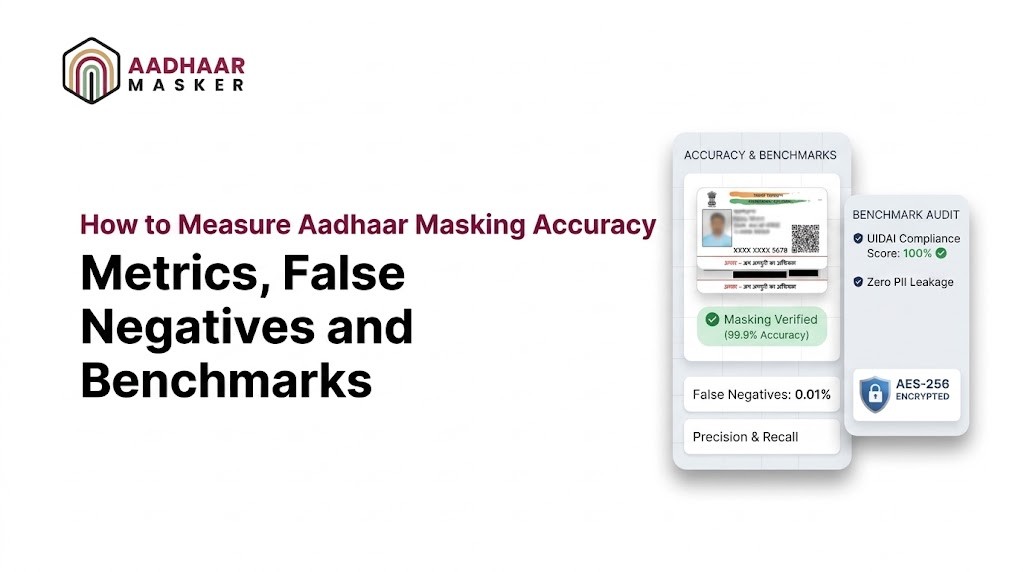
When an organization evaluates an Aadhaar masking solution, accuracy is the first word that appears in every vendor conversation. Every solution claims high accuracy. Few explain what that claim actually means, how it is measured, or what failure looks like in production. The result is that procurement teams sign contracts based on accuracy numbers that are not directly comparable — different vendors measure different things, under different conditions, using different definitions of success and failure.
Aadhaar masking accuracy is not a single number. It is a composite of several distinct performance dimensions, each of which affects compliance outcomes in a different way. A solution that claims 99% accuracy might be leaving one document in every hundred with an exposed Aadhaar number — a false negative rate that is commercially unacceptable for high-volume operations. Understanding what to measure, how to measure it and what benchmarks to hold vendors to is essential before making a procurement decision.
This blog provides a structured framework for evaluating Aadhaar masking accuracy: the metrics that matter, the distinction between false negatives and false positives, the conditions under which accuracy should be tested and how to run a meaningful benchmark against vendor claims.
Why Accuracy Measurement Is Not Straightforward
Aadhaar masking involves two sequential tasks: detecting the Aadhaar number within a document image, and applying the mask correctly to the detected region. Accuracy can fail at either stage, in different ways, with different consequences.
Detection failure means the system does not locate the Aadhaar number in the document. This produces a false negative — the document is returned without a mask, and the full Aadhaar number remains visible. Detection failure is the more dangerous error type because the downstream system receives what appears to be a processed document but is in fact non-compliant.
Masking failure means the system detects the Aadhaar number but applies the mask incorrectly — covering the wrong region, covering an incomplete portion of the number, or producing a mask that obscures the wrong digits. This is less common with mature solutions but represents a distinct failure mode that should be tested separately.
An accuracy number that does not distinguish between these failure modes does not give a procurement team the information they need to assess compliance risk. A vendor that reports "99.5% accuracy" should be asked to specify whether that figure refers to detection accuracy, masking placement accuracy or end-to-end accuracy across both stages.
The Core Metrics for Aadhaar Masking Accuracy
Detection Rate (True Positive Rate)
The detection rate measures the percentage of documents in which the Aadhaar number is correctly located. A detection rate of 98% means the system successfully finds the Aadhaar number in 98 out of every 100 documents. The remaining 2% are false negatives — documents returned without a mask.
Detection rate is the most critical metric for compliance purposes. Any document with a false negative is a compliance failure. For organizations processing thousands of documents per day, even a 1% false negative rate translates to tens of non-compliant documents daily.
False Negative Rate
The false negative rate is the complement of the detection rate: the percentage of documents where the Aadhaar number is present but not detected. A false negative rate of 2% means 2 in every 100 documents processed by the system are returned without a mask.
This metric must be evaluated in the context of document volume. For an organization processing 500 documents per day, a 2% false negative rate produces 10 unmasked documents every day. Over a month, that is 300 non-compliant records. The false negative rate should be evaluated against the organization's document volume to understand the actual compliance gap it creates.
False Positive Rate
A false positive occurs when the system masks content that is not an Aadhaar number — for example, masking a phone number, a date of birth or a reference number that resembles the 12-digit Aadhaar format. False positives do not create compliance risk in the way false negatives do, but they affect document usability. A document with an incorrectly masked field may require manual review before it can be used.
A low false positive rate matters most in documents with multiple numeric fields — financial documents, voter ID cards accompanying an Aadhaar, or documents containing reference numbers that resemble 12-digit sequences.
Masking Placement Accuracy
Once the Aadhaar number is detected, the mask must be applied correctly. Masking placement accuracy measures whether the mask covers exactly the first eight digits of the Aadhaar number, leaving the last four visible. Partial masking — where only some of the first eight digits are obscured — is a compliance failure even if detection was successful.
Masking placement accuracy is affected by document orientation, font size variations, digit spacing and the resolution of the source image. A solution that places masks accurately on high-resolution scans may perform less reliably on mobile-captured photos with perspective distortion.
QR Code Masking Accuracy
Aadhaar cards contain a QR code that encodes the full Aadhaar number along with demographic data. A solution that masks the printed number but leaves the QR code intact provides incomplete protection — the full Aadhaar number remains recoverable by anyone with a QR scanner. QR code masking accuracy measures whether the solution correctly identifies and neutralizes the QR code embedded in the document.
This metric is especially important because many legacy masking solutions were designed before QR masking became a standard requirement and do not handle it correctly.
End-to-End Accuracy
End-to-end accuracy is the composite metric: the percentage of documents where the solution correctly detects the Aadhaar number, correctly masks the first eight digits of the printed number and correctly neutralizes the QR code. This is the number that most directly maps to compliance outcomes. A document is either fully masked or it is not. Partial success at any stage is a failure for compliance purposes.
Understanding False Negatives in Production Conditions
False negatives are the most consequential accuracy failure, and they are strongly correlated with document quality conditions that differ between vendor test environments and real-world production.
Vendor benchmark datasets are often composed of high-quality document images: clear scans, good lighting, minimal distortion. Production document sets include images captured under suboptimal conditions. The gap between benchmark accuracy and production accuracy can be significant, and organizations that do not test against realistic document samples may be surprised by real-world performance.
Document Conditions That Increase False Negative Risk
Low Image Resolution
Mobile cameras on older handsets or documents captured from a distance produce low-resolution images in which the Aadhaar number digits may not be clearly distinguishable. OCR systems that perform well on 300 DPI scans may fail on 72 DPI mobile captures.
Poor Lighting and Shadows
Documents photographed in poor lighting, with shadows across the Aadhaar number region, or with glare from reflective card surfaces reduce OCR detection reliability.
Skew and Perspective Distortion
Documents captured at an angle — a common occurrence in field onboarding — introduce perspective distortion that can make digit recognition unreliable for systems without robust deskewing preprocessing.
Physical Document Damage
Laminated cards with scratches, worn edges, or partial tears may obscure some digits of the Aadhaar number. A detection system must handle partial occlusion of the number string.
Non-Standard Document Formats
Aadhaar documents exist in multiple formats: the physical PVC card, the printed paper Aadhaar downloaded from UIDAI, the e-Aadhaar PDF and the mAadhaar app screenshot. Each format has a different visual layout, font rendering and background design. A solution trained primarily on one format may underperform on others.
Multilingual Documents
Aadhaar cards print the holder's name and address in both English and a regional language. Documents where the Aadhaar number appears near dense regional script text may present detection challenges for systems with limited multilingual OCR capability.
How to Run a Meaningful Accuracy Benchmark
Benchmarking an Aadhaar masking solution requires a structured test protocol that evaluates performance under realistic conditions, not just ideal ones. The following steps constitute a rigorous benchmark process.
Step 1: Build a Representative Test Dataset
Compile a test dataset that reflects the actual document types and quality conditions your organization encounters. This should include:
- *High-quality scanned documents (control group)
- *Mobile-captured photos at varying resolutions
- *Documents captured under poor lighting conditions
- *Skewed and perspective-distorted documents
- *Worn or partially damaged physical cards
- *All Aadhaar document formats (physical card, e-Aadhaar, mAadhaar screenshot)
- *Documents with regional language content
- *Documents where the Aadhaar number appears near other numeric fields
A dataset of 200 to 500 documents across these categories provides a statistically meaningful basis for comparison. Ground-truth annotation — a human-verified record of the correct Aadhaar number and its location in each document — is required to evaluate detection accuracy objectively.
Step 2: Define Success and Failure Criteria
Before running the benchmark, define what constitutes a successful masking outcome. A recommended definition:
- *The first eight digits of the printed Aadhaar number are obscured
- *The last four digits remain legible
- *The QR code is neutralized (either removed or replaced with a non-scannable placeholder)
- *No other content in the document is incorrectly masked
Any document that does not meet all four criteria is a failure for the purpose of the benchmark.
Step 3: Submit the Full Dataset to Each Vendor
Submit the same dataset to each vendor being evaluated, using the vendor's production API or processing interface rather than a demo environment. Demo environments are sometimes configured differently from production — testing against the production system gives results that reflect actual deployment performance.
Step 4: Calculate Metrics Across All Documents and Subcategories
Calculate end-to-end accuracy, false negative rate, false positive rate and masking placement accuracy for the full dataset and for each subcategory. Subcategory analysis reveals where each vendor's solution underperforms — a solution that is strong on high-quality scans but weak on mobile photos may not be appropriate for a mobile-first onboarding workflow.
Step 5: Review Failure Cases Manually
For each document where a failure occurred, determine whether it was a detection failure, a placement failure or a QR code masking failure. This failure mode analysis informs how the solution should be integrated — for example, whether a human review queue is needed for a specific document category.
Step 6: Retest After Vendor Optimization
Share the failure cases with each vendor and ask whether the failures represent known limitations or whether the solution can be improved for those document types. Vendors who can improve performance after reviewing failure cases demonstrate a more capable and responsive development team than those who cannot.
Benchmarks: What Accuracy Numbers Should You Expect?
Industry benchmarks for Aadhaar masking accuracy vary based on document quality conditions. The following ranges reflect realistic production performance for solutions evaluated across diverse document sets.
High-Quality Scanned Documents
For documents captured at 200 DPI or above, with good lighting and minimal distortion, a mature masking solution should achieve end-to-end accuracy of 98% to 99.5%. False negative rates in this category below 1% are achievable with well-trained systems.
Mobile-Captured Documents Under Normal Conditions
For mobile photos captured with a modern smartphone under reasonable lighting, accuracy should be in the 95% to 98% range. Solutions with strong image preprocessing — deskewing, contrast enhancement, resolution upscaling — perform at the higher end of this range.
Poor-Quality or Degraded Documents
For documents captured under poor conditions — low lighting, significant skew, partial damage — accuracy typically falls to the 85% to 93% range even for capable solutions. Any vendor claiming above 95% end-to-end accuracy on a genuinely diverse poor-quality dataset should be asked to provide supporting data, as this range is unusual without human review assistance.
QR Code Masking
QR code detection and neutralization should achieve at least 97% accuracy on documents where a QR code is present. Solutions that do not handle QR masking at all — a common gap in older tools — should be disqualified from evaluation when compliance with UIDAI guidelines is a requirement.
AI vs Rule-Based Solutions: Accuracy Implications
The choice of detection approach fundamentally determines accuracy ceiling and failure mode distribution. AI vs rule-based Aadhaar masking is a comparison that matters directly for the accuracy metrics discussed above.
Rule-based masking solutions detect the Aadhaar number by looking for a specific pattern — a 12-digit sequence formatted as XXXX XXXX XXXX or XXXXXXXXXXXX. These solutions perform well when the document is high quality and the Aadhaar number appears in the expected format with standard spacing. They fail when the number is partially obscured, when OCR pre-processing introduces character recognition errors, or when the document format deviates from the expected template.
AI-powered masking solutions use computer vision models trained on large datasets of Aadhaar documents. These models learn to locate the Aadhaar number based on its visual context — the surrounding text, the card layout, the relative position of the number within the document — rather than relying solely on pattern matching. This contextual understanding makes AI-based solutions significantly more robust on degraded and non-standard documents.
In benchmark testing across diverse document quality conditions, AI-based solutions consistently outperform rule-based approaches on false negative rate, particularly for mobile-captured and poor-quality documents. The accuracy gap between approaches is most pronounced in the document categories where masking failures are most likely to occur in production.
When evaluating vendors, ask specifically whether the detection engine is pattern-based, model-based or a hybrid. The answer directly determines how the solution will perform on the lower-quality portion of your document set — which is where compliance risk is highest.
Integrating Accuracy Monitoring into Production
Benchmarking before procurement is necessary but not sufficient. Aadhaar masking accuracy in production should be monitored continuously, because document quality conditions change over time — a new document intake channel, a geographic expansion, a change in the mobile devices used by field agents can all shift the distribution of incoming documents and affect accuracy.
Confidence Scores and Low-Confidence Routing
A well-designed masking API returns a confidence score alongside the masked document — a measure of how certain the detection engine is that it correctly identified and masked the Aadhaar number. Documents below a confidence threshold can be routed automatically to a human review queue rather than passed directly into the downstream workflow.
Implementing a confidence-based routing rule effectively creates a two-tier processing system: high-confidence documents flow through automatically, while low-confidence documents receive human verification. This architecture significantly reduces the false negative rate that reaches downstream systems, even when the base detection accuracy is imperfect.
Sampling and Spot-Check Audits
Establish a regular sampling process in which a random percentage of processed documents — typically 1% to 5% — are manually reviewed to verify correct masking. Sampling audits detect accuracy degradation before it accumulates into a significant compliance gap and provide ongoing evidence that the masking process is functioning correctly.
Failure Logging and Pattern Analysis
Log every document that is flagged for manual review or returned with a low confidence score. Analyze these logs periodically to identify patterns — a specific document type, a geographic region, a particular intake channel — that consistently produce failures. Pattern analysis allows targeted remediation: improving preprocessing for a specific document type, retraining the model on a new document format or adjusting the confidence threshold for a specific workflow.
SLA Monitoring
Track masking latency alongside accuracy. A solution that achieves high accuracy only by increasing processing time may create bottlenecks in high-volume onboarding workflows. The accuracy-latency tradeoff should be part of ongoing production monitoring, not just the initial benchmark.
What to Ask Vendors About Accuracy
When evaluating masking vendors, the following questions distinguish solutions with rigorous accuracy measurement from those relying on marketing claims:
- *What does your quoted accuracy figure measure — detection rate, end-to-end accuracy or masking placement accuracy?
- *What was the composition of the benchmark dataset — resolution distribution, document format mix, lighting conditions?
- *What is your false negative rate on mobile-captured documents specifically?
- *Does your solution mask the QR code in addition to the printed Aadhaar number?
- *What confidence scoring does the API return, and how should we configure our low-confidence routing threshold?
- *How does accuracy change between your benchmark dataset and real-world production environments?
- *What is the accuracy of your solution on e-Aadhaar PDFs versus physical card images?
- *Can you provide accuracy data broken down by document quality category?
- *What is your process for improving accuracy when customers report failure cases?
A vendor who cannot answer these questions with specific data — not general assurances — has not invested in rigorous accuracy measurement and is unlikely to perform reliably in production.
The Cost of Accuracy Gaps
Organizations sometimes treat accuracy as a secondary consideration after price and integration complexity. The cost of accuracy gaps, however, is not theoretical.
A false negative rate of 2% at 1,000 documents per day produces 20 unmasked documents daily. Each unmasked document is a UIDAI compliance violation. If those documents are shared with a vendor or stored in a system that is later audited, each one is evidence of non-compliance. Under the Digital Personal Data Protection Act, repeated compliance failures can result in regulatory penalties. Beyond regulatory risk, a data breach involving a document store that contains unmasked Aadhaar numbers is a reputational event with long-term consequences.
The cost of a masking solution with high accuracy is typically modest relative to the compliance and breach risk it eliminates. Evaluating vendors primarily on price while accepting a higher false negative rate is a tradeoff that most organizations would not make if they calculated the expected cost of the resulting compliance gap.
Conclusion
Aadhaar masking accuracy is a multi-dimensional performance characteristic that requires specific, structured measurement to evaluate meaningfully. Detection rate, false negative rate, false positive rate, masking placement accuracy and QR code masking accuracy are each distinct metrics with different compliance implications. A single accuracy number without decomposition into these components is insufficient for procurement decisions.
Running a rigorous benchmark — with a representative test dataset, clear success criteria and subcategory analysis — provides the evidence needed to hold vendors to their claims and to predict real-world performance. Supplementing benchmark testing with ongoing production monitoring, confidence-based routing and sampling audits ensures that accuracy is maintained as document conditions evolve.
Organizations that measure accuracy rigorously before and after deployment are able to demonstrate — to regulators, to auditors and to their own boards — that their Aadhaar masking process is functioning correctly and that compliance gaps are identified and remediated before they accumulate into significant liability.
Measure Accuracy. Eliminate False Negatives. Stay Compliant.
Our AI-powered Aadhaar masking solution delivers industry-leading accuracy across all document types — from high-quality scans to mobile-captured photos — with confidence scoring, QR code masking and detailed audit logs built in. Run a benchmark on your own document set and see how our accuracy compares to your current process or any competing solution.
- *End-to-end accuracy measurement with false negative reporting
- *Confidence-score-based routing for low-quality documents
- *QR code detection and neutralization included as standard
Request a Personalized Demo and benchmark our solution against your real-world document set before you commit.



Top Posts
- Why Accuracy Measurement Is Not Straightforward
- The Core Metrics for Aadhaar Masking Accuracy
- Understanding False Negatives in Production Conditions
- How to Run a Meaningful Accuracy Benchmark
- Benchmarks: What Accuracy Numbers Should You Expect?
- AI vs Rule-Based Solutions: Accuracy Implications
- Integrating Accuracy Monitoring into Production
- What to Ask Vendors About Accuracy
- The Cost of Accuracy Gaps
- Conclusion