
Aadhaar Masking for Staffing Firms, Gig Platforms and Logistics Companies
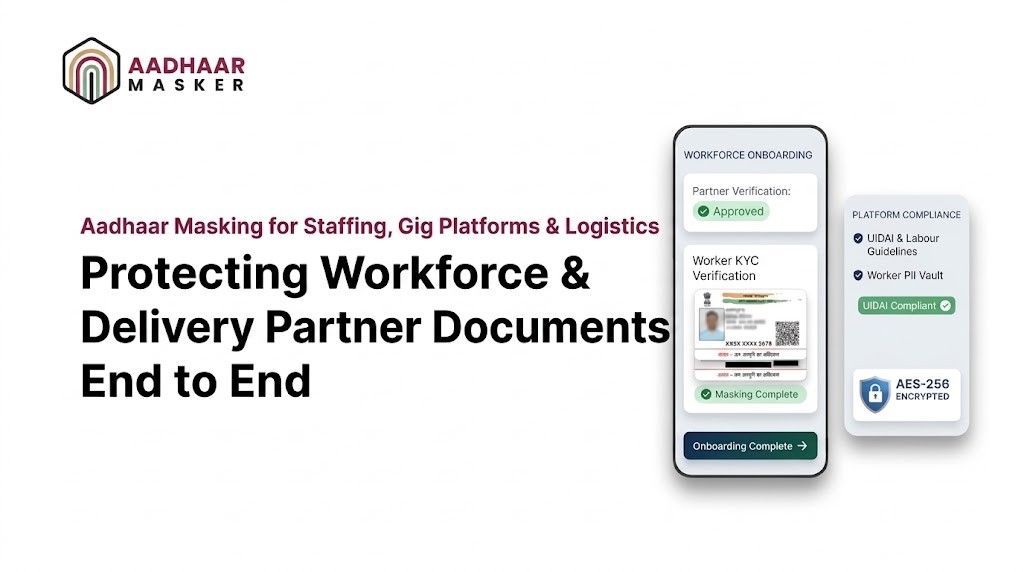
Staffing firms, gig platforms and logistics companies share a problem that most enterprise software discussions do not adequately address: they onboard workers at a scale and speed that make document compliance genuinely difficult. A ride-hailing platform may activate thousands of new drivers in a single week. A staffing agency placing contract workers at warehouses processes hundreds of Aadhaar copies every day. A last-mile logistics operator may have tens of thousands of delivery partners distributed across dozens of cities.
In each of these businesses, Aadhaar documents are collected routinely, stored across multiple systems and shared with third parties — background verification agencies, payment processors, insurance providers and compliance teams. The volume is high, the velocity is fast and the exposure risk is significant. Aadhaar masking for gig platforms and related high-volume workforce industries is not a theoretical compliance exercise. It is a practical operational requirement that affects onboarding speed, vendor risk and regulatory standing under UIDAI guidelines and the Digital Personal Data Protection (DPDP) Act.
This blog explains where Aadhaar documents accumulate in staffing, gig and logistics operations, why the exposure risk is higher than in most enterprise contexts, and how automated masking solves the problem without creating friction in onboarding.
Why These Three Sectors Face a Unique Aadhaar Exposure Problem
Most organizations that handle Aadhaar data deal with it in manageable volumes — a bank collects Aadhaar during account opening, a hospital collects it during patient registration, an insurance company collects it at policy issuance. The numbers are significant but the processes are often structured and relatively controlled.
Staffing firms, gig platforms and logistics operators face a different situation. Their Aadhaar exposure is characterized by three factors that make it particularly high-risk:
Volume
These businesses onboard workers continuously and at scale. A pan-India staffing firm may process 500 to 5,000 worker documents per day. A major food delivery platform may onboard 10,000 delivery partners per month during peak hiring cycles. This volume means that even a small process gap — such as not masking Aadhaar copies before sharing with third-party vendors — creates an enormous data exposure footprint.
Distribution
Workers, agents and document processors are spread across cities and states. Documents often enter the system through mobile apps, field agent uploads, WhatsApp forwards and email attachments before reaching a central server. Each entry point is a potential vulnerability if documents are not masked at the point of collection.
Third-Party Dependency
Background verification, police verification, insurance enrollment and payment onboarding all involve third-party platforms. Unmasked Aadhaar copies are routinely shared with these vendors because the sharing happens quickly and informally. Each vendor who receives an unmasked document is a point of potential misuse or breach.
Staffing Firms: Aadhaar Across the Full Talent Lifecycle
Staffing agencies manage large volumes of worker documents from recruitment through deployment and sometimes beyond. The Aadhaar document, in particular, moves through several hands before it is filed.
During Recruitment
Candidates submit Aadhaar copies through job portals, agency portals or directly to field recruiters. Many staffing firms still collect documents via WhatsApp or email, meaning unmasked Aadhaar copies sit in recruiter inboxes across the organization.
During Background Verification
Staffing firms typically partner with one or more BGV agencies that require identity documents as part of the verification process. The standard practice of sending full, unmasked Aadhaar copies to these agencies creates vendor risk that can be entirely avoided with an automated aadhar masking solution.
During Deployment
When a worker is placed at a client site, the client often receives a copy of the worker's Aadhaar for access control or site compliance purposes. This is a third point of exposure that most staffing firms do not actively manage through masking.
During Payroll and Statutory Compliance
EPF, ESIC and professional tax filings require Aadhaar-linked data. Payroll processors need to reference Aadhaar numbers, but in most cases they need only the last four digits or a system-generated token — not the full unmasked document.
An Aadhaar Masking API integrated into the staffing firm's ATS or workforce management platform can automatically mask every Aadhaar document at the point of upload, ensuring that only masked copies enter any downstream workflow or vendor system.
Gig Platforms: Speed Without Sacrificing Compliance
Gig platforms — ride-hailing apps, food delivery platforms, freelance marketplaces and home services aggregators — compete on onboarding speed. A delivery partner who can be activated in 24 hours is a competitive advantage. That pressure creates a systematic tension with document compliance: masking feels like a step that slows things down.
In practice, aadhaar masking for gig platforms does not add meaningful time to the onboarding flow when it is implemented correctly. An automated masking step that processes a document in under two seconds and returns a compliant masked copy is invisible to the worker and the onboarding coordinator. The compliance benefit, however, is substantial.
Mobile-First Document Collection
Gig workers typically submit their Aadhaar copies through a mobile app. The app captures a photo of the physical card or accepts a PDF upload. If the platform's backend sends the uploaded document directly to an Aadhaar Masking API before storing it, masking happens automatically with no additional step for the worker or the platform team.
Bulk Onboarding Events
Gig platforms often run large-scale onboarding drives — city launches, festive season hiring, expansion into new regions. These events can generate thousands of Aadhaar documents within days. A bulk-capable masking solution handles this surge without manual intervention, ensuring that the compliance process scales with the business.
Partner and Vendor Sharing
Gig platforms share worker data with payment gateways, insurance providers, and in some cases with their enterprise clients. Each sharing event involving an unmasked Aadhaar document is a compliance gap. Storing only masked copies in the platform's database ensures that any downstream sharing automatically involves only masked documents.
Deactivation and Re-Activation Cycles
Gig workers frequently go inactive and return to platforms. If the platform retains unmasked Aadhaar copies in long-term storage, those documents accumulate significant data retention risk. A masking-first approach ensures that historical records are compliant from day one, eliminating the need for a retroactive masking exercise later.
Logistics Companies: Managing Aadhaar for a Distributed Driver and Delivery Network
Logistics operators — trucking aggregators, courier companies, last-mile delivery platforms and cold chain operators — manage large networks of drivers and delivery partners whose Aadhaar documents are required for vehicle registration compliance, insurance, toll and traffic authority interactions, and statutory filings.
Driver Onboarding and License Verification
Logistics companies collect Aadhaar alongside driving licenses and vehicle registration certificates during driver onboarding. These documents are shared with transport authorities, insurance underwriters and enterprise clients. The Aadhaar component of this document set should be masked before any external sharing occurs.
Multi-City Operations
A logistics operator with hubs across 20 cities may have local HR teams or franchise operators collecting Aadhaar documents independently. Without a centralized aadhar masking solution integrated into the document submission workflow, compliance is inconsistent across locations.
Vehicle-Owner and Fleet-Partner Onboarding
Asset-light logistics models partner with individual truck owners and fleet operators. These partners submit Aadhaar copies as part of the KYC process. The volume of such submissions, spread across a wide geographic area, makes manual masking unworkable and automated masking essential.
Police and Traffic Authority Requirements
Some logistics routes require document submission to police authorities or transport departments for route permits. Sharing masked Aadhaar copies for these purposes — where identity confirmation rather than full data access is the requirement — is permissible and preferable.
How Real-Time Aadhaar Masking Fits into These Workflows
The unifying requirement across staffing, gig and logistics operations is speed. These businesses cannot afford a masking process that adds hours or days to document processing. Real-time Aadhaar masking is the operational model that makes compliance compatible with high-velocity onboarding.
A real-time masking API receives a document upload, processes the image or PDF using AI-powered OCR to detect the Aadhaar number, applies the mask to the first eight digits and returns the masked document — all within seconds. This latency is comparable to a standard file upload confirmation. From the worker's or partner's perspective, nothing changes in the onboarding experience. From the compliance team's perspective, every document that enters the system is already masked.
Integration Points
For staffing firms, the masking API integrates with the ATS or recruitment management system. For gig platforms, it connects to the partner app backend or the document intake service. For logistics companies, it plugs into the driver onboarding portal or the fleet management system. In all three cases, the integration is a standard REST API call that most engineering teams can implement in a day or two.
Handling Document Variety
Worker-submitted documents in these sectors are rarely uniform. They include clear scans, mobile photographs, low-light captures, slightly skewed images and documents with handwritten annotations. An AI-powered masking engine handles this variety accurately, detecting the Aadhaar number even in imperfect document images and applying the mask without manual review.
QR Code Masking
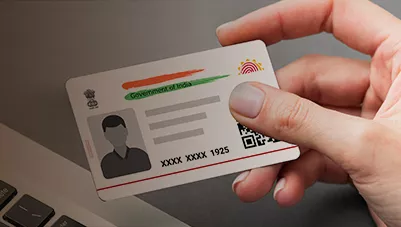
Aadhaar cards contain a QR code that embeds personal data including the full Aadhaar number. Masking only the printed number while leaving the QR code intact is an incomplete compliance measure. A complete masking solution masks both the printed digits and the QR code data, ensuring that neither visual inspection nor a QR scanner can recover the full Aadhaar number from a stored document.
DPDP Act Compliance for High-Volume Distributed Workforces
The Digital Personal Data Protection Act introduces obligations that apply directly to how staffing firms, gig platforms and logistics companies handle worker Aadhaar data.
Purpose Limitation
Aadhaar data collected for identity verification during onboarding should not be used for any other purpose without explicit consent. Storing full unmasked Aadhaar copies when only the last four digits are needed for most downstream processes violates this principle.
Data Minimization
Organizations must collect only the minimum data necessary for the stated purpose. A masked Aadhaar copy that shows only the last four digits satisfies identity confirmation requirements in most contexts, making full Aadhaar storage unnecessary for routine workflows.
Security of Personal Data
The DPDP Act requires organizations to implement appropriate technical measures to protect personal data. Automated aadhaar masking for gig platforms and workforce operations is one of the most concrete technical controls available — it converts a high-value data asset (the full Aadhaar number) into a lower-risk form at the earliest point in the workflow.
Third-Party Data Processor Obligations
BGV agencies, payment processors and insurance providers who receive worker documents are data processors under the DPDP Act. The staffing firm, gig platform or logistics operator who shares those documents remains the data principal and bears responsibility for ensuring that shared data is handled appropriately. Sharing only masked documents limits the data processor's access to full Aadhaar information and reduces the principal's liability if the processor experiences a breach.
Retention and Deletion
Worker data should not be retained beyond the period required for the stated purpose. Logistics companies and gig platforms often retain worker documents for years — sometimes indefinitely — without a clear retention policy. Masked copies are safer to retain, and organizations that have adopted masking-first workflows have an easier time demonstrating compliance with retention principles during regulatory audits.
Risks of Operating Without Aadhaar Masking in These Sectors
Organizations in staffing, gig and logistics that have not implemented automated Aadhaar masking face a set of risks that compound with scale.
Data Breach Exposure at Scale
A database containing 500,000 unmasked Aadhaar copies is a target. A breach of this database exposes a large number of workers to identity fraud. Masked copies dramatically reduce the value of such a breach because the exposed data cannot be used to access Aadhaar-linked services.
Informal Sharing Channels
In fast-moving operations, workers and coordinators share documents through WhatsApp, email and cloud storage links. Each informal share of an unmasked Aadhaar document represents an uncontrolled data exposure. Masking at the point of collection ensures that even if these informal channels are used, the document that travels through them is already compliant.
Vendor Risk Multiplication
A logistics company working with 15 BGV agencies, 3 insurance providers and 8 regional compliance vendors across its network has at least 26 potential points of Aadhaar data exposure. If each of those vendors receives unmasked copies, the total exposure scales accordingly. Sharing only masked documents limits the exposure regardless of how many vendors are in the network.
Regulatory and Reputational Risk
As DPDP Act enforcement matures, organizations that cannot demonstrate adequate Aadhaar data protection practices will face scrutiny. For gig platforms and logistics companies, whose brand is closely tied to trust with their worker communities, a data breach or regulatory action involving worker Aadhaar data can cause significant long-term reputational damage.
What to Look for in an Aadhaar Masking Solution for These Sectors
Not every masking solution is built for the volume and document variety that staffing, gig and logistics operations generate. Evaluating a solution for these sectors requires attention to specific capabilities.
High-Volume API Throughput
The Aadhaar Masking API must handle concurrent requests without degradation. A platform onboarding 1,000 workers in a day needs to process 1,000 masking requests within a normal business day's operational window. Look for solutions with documented throughput capacity and SLA guarantees.
Accuracy Across Document Types
Worker-submitted documents are diverse. Mobile photos taken in poor lighting, slightly crumpled physical cards and low-resolution PDF scans are common. The masking engine must accurately detect the Aadhaar number across this variety, with a documented accuracy rate and clear behavior for edge cases where detection fails.
Bulk Processing Mode
During onboarding drives, documents may arrive faster than real-time API processing can handle. A bulk processing mode allows organizations to submit batches of documents for asynchronous masking, with results returned when processing is complete.
Mobile SDK or Lightweight Integration
Gig platforms with mobile-first onboarding benefit from a mobile SDK that integrates directly into the app, allowing masking to happen on the device before the document is transmitted. This further reduces data exposure by ensuring that the unmasked document never leaves the worker's device.
Audit Trail and Compliance Reporting
Demonstrating compliance with UIDAI guidelines and the DPDP Act requires evidence. The masking solution should maintain tamper-evident logs of which documents were masked, when and through which workflow — providing an audit trail that supports both internal governance and external regulatory inquiries.
Deployment Flexibility
Logistics operators with stringent data residency requirements may need on-premise deployment. Gig platforms with global infrastructure may prefer cloud-native deployment. A capable solution supports both models and can accommodate hybrid architectures where some processing happens on-premise and some in the cloud.
Best Practices for Implementing Aadhaar Masking in These Operations
Technology implementation alone is not sufficient. Organizations should pair automated masking with operational practices that reinforce the compliance objective.
- *Mask at the point of collection — before the document enters any storage, workflow or vendor system.
- *Eliminate informal document sharing channels such as WhatsApp groups and personal email, or ensure that only masked copies are circulated through these channels.
- *Define and enforce a data retention schedule for worker Aadhaar documents, including masked copies.
- *Restrict access to original unmasked documents to a minimum number of authorized personnel with a documented justification for each access event.
- *Include masking requirements in vendor contracts with BGV agencies, insurance providers and payment processors.
- *Conduct periodic audits of existing document stores to identify and retroactively mask any unmasked Aadhaar copies in legacy systems.
- *Train field agents and onboarding coordinators on masking procedures and the reason behind them.
- *Monitor API performance and masking accuracy rates regularly and investigate any detection failures before they accumulate.
Conclusion
Staffing firms, gig platforms and logistics companies operate in an environment where Aadhaar compliance cannot be managed manually. The volumes are too high, the distribution too wide and the velocity too fast for any team-based process to keep pace. Automated aadhaar masking for gig platforms and workforce operations is the only approach that scales reliably.
An AI-powered aadhar masking solution with a high-throughput Aadhaar Masking API integrates into existing onboarding workflows and masks every document at the point of upload — with no additional burden on the worker or the operations team. The result is a document management process that is simultaneously faster, safer and more compliant than the manual alternative.
Organizations that build masking into their onboarding infrastructure today will be better positioned for DPDP Act enforcement, better protected against data breach liability and better trusted by the workers and partners who rely on them to handle sensitive identity documents responsibly.
Scale Your Onboarding. Protect Every Aadhaar Document.
Automate Aadhaar masking across your staffing, gig or logistics onboarding workflows with our AI-powered Aadhaar Masking Solution. Connect your partner app, ATS or fleet management platform using our high-throughput Aadhaar Masking API and ensure every worker document is masked from the moment it enters your system.
- *High-volume API throughput for large-scale onboarding
- *Bulk processing mode for onboarding drives and city launches
- *DPDP-ready compliance controls with audit logging
Request a Personalized Demo and see how your operations team can protect worker Aadhaar data at scale without slowing down onboarding.



Top Posts
- Why These Three Sectors Face a Unique Aadhaar Exposure Problem
- Staffing Firms: Aadhaar Across the Full Talent Lifecycle
- Gig Platforms: Speed Without Sacrificing Compliance
- Logistics Companies: Managing Aadhaar for a Distributed Driver and Delivery Network
- How Real-Time Aadhaar Masking Fits into These Workflows
- DPDP Act Compliance for High-Volume Distributed Workforces
- Risks of Operating Without Aadhaar Masking in These Sectors
- What to Look for in an Aadhaar Masking Solution for These Sectors
- Best Practices for Implementing Aadhaar Masking in These Operations
- Conclusion