
The Complete Enterprise Guide to Aadhaar Masking: Implementation, Security, AI and Compliance (2026)
What Is Aadhaar Masking?
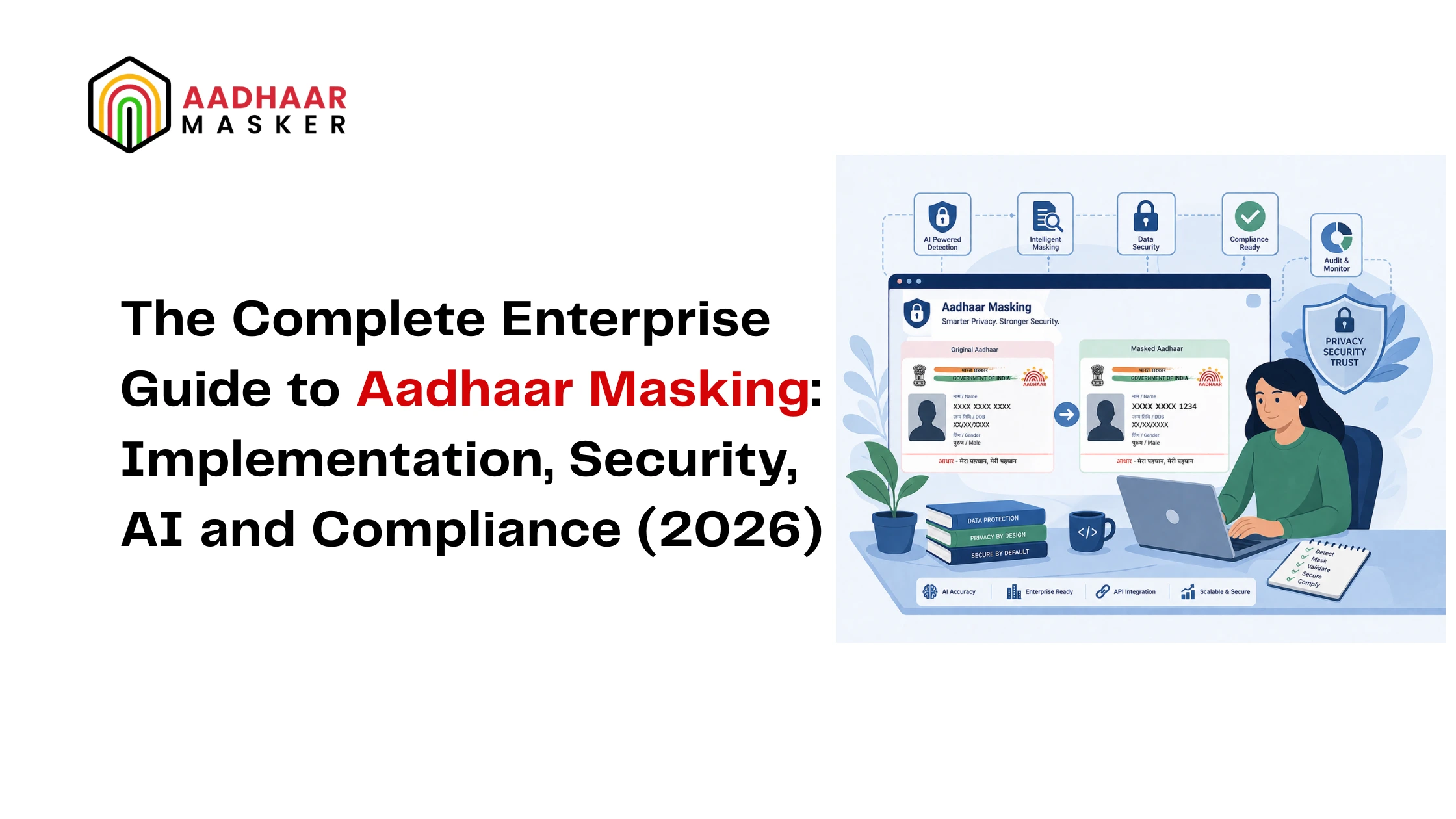
Aadhaar masking is the process of hiding the first eight digits of an Aadhaar number while displaying only the last four digits (XXXX-XXXX-1234). It helps organizations reduce unnecessary exposure of sensitive identity information while allowing documents to remain usable for verification and operational purposes.
By integrating Aadhaar masking into document workflows, enterprises can strengthen privacy, improve security and support responsible handling of personal data.
The accuracy of automated masking depends on the underlying detection approach, making it important to compare AI vs rule-based Aadhaar masking.
Why Is Aadhaar Masking Important for Enterprises?
Organizations across banking, fintech, insurance, healthcare, telecom and government process Aadhaar documents through onboarding, KYC and document management systems. As these documents move across multiple platforms, the risk of exposing sensitive identity information increases.
Automated Aadhaar masking reduces manual effort, improves document security and supports privacy-first data handling. Learn why Manual Aadhaar Redaction Is No Longer Safe for Enterprise Document Processing.
For long-term record management, enterprises should also consider Aadhaar masking for digital document archiving to protect sensitive records over time.
Who Should Use Aadhaar Masking?
Any organization that collects or stores Aadhaar documents can benefit from Aadhaar masking. Banks, NBFCs, insurance companies, healthcare providers, telecom operators, government departments and enterprises use masking to protect customer, employee and vendor identity information throughout the document lifecycle.
Where and When Should Aadhaar Masking Be Applied?
Aadhaar masking should be applied as early as possible, ideally immediately after document upload and before storage, sharing or further processing. Integrating masking throughout the document lifecycle—from document capture and AI detection to validation, storage, access control and audit logging—helps reduce privacy risks.
Organizations managing long-term records should also consider Aadhaar Masking for Digital Document Archiving, while enterprises adopting modern security models can explore How Aadhaar Masking Supports Zero Trust Security Architecture.
How AI Aadhaar Masking Works
Modern Aadhaar masking software combines OCR, AI and document intelligence to identify Aadhaar numbers across scanned documents, images and PDFs. The workflow typically includes document detection, OCR extraction, Aadhaar identification, masking, validation and secure output generation.
AI-powered masking provides greater accuracy than traditional rule-based methods by understanding document context and adapting to different layouts and image qualities. Learn more in How AI Detects Aadhaar Numbers Hidden Inside Scanned PDFs and Images and AI vs Rule-Based Aadhaar Masking.
Choosing the Right Aadhaar Masking Solution
Organizations should evaluate Aadhaar masking solutions based on detection accuracy, AI capabilities, API integration, security, scalability, workflow compatibility and audit support. The ideal solution integrates seamlessly with existing KYC platforms, document management systems and enterprise applications.
If you plan to automate enterprise workflows, read How Aadhaar Masking APIs Integrate with Existing KYC and Document Management Systems.
Aadhaar Masking, Compliance and DPDP
UIDAI-compliant Aadhaar masking is only one aspect of enterprise data protection. Organizations should also implement secure storage, access controls, encryption, audit logging and data retention policies as part of their overall privacy framework.
Before selecting an architecture, enterprises should compare on-premise vs cloud Aadhaar masking based on their security, scalability and data-processing requirements.
Deployment and Implementation Best Practices
Organizations can deploy Aadhaar masking using cloud-based or on-premise architectures depending on business and compliance requirements. Before implementation, they should define masking policies, validate OCR accuracy, integrate APIs, implement role-based access controls and regularly monitor workflow performance.
To avoid deployment challenges, read Top 10 Mistakes Organizations Make When Implementing Aadhaar Masking.
The Future of Aadhaar Masking
The future of Aadhaar masking lies in AI-powered document understanding, intelligent document processing, privacy engineering and API-driven automation. Organizations will increasingly adopt real-time masking, context-aware privacy controls and privacy-by-design workflows to strengthen enterprise document security.
Conclusion
As digital onboarding and document processing continue to grow, Aadhaar masking has become an essential privacy and security measure for modern enterprises. AI-powered masking solutions help organizations automate document protection, reduce manual effort and integrate privacy into existing workflows.
By combining AI, OCR, secure APIs, governance and access controls, enterprises can build scalable Aadhaar protection strategies that support both operational efficiency and long-term compliance.
Future-Proof Your Aadhaar Privacy Strategy
Prepare your organization for the next generation of document security with Pix Dynamics Aadhaar Masking Solution. Leverage AI-powered detection, intelligent document processing, secure APIs and automated masking to protect Aadhaar data, streamline compliance and integrate privacy into every stage of your enterprise workflows.
Request a Free Demo and discover how Pix Dynamics can help you build a smarter, scalable and future-ready Aadhaar masking solution.


Top Posts
- What Is Aadhaar Masking?
- Why Is Aadhaar Masking Important for Enterprises?
- Who Should Use Aadhaar Masking?
- Where and When Should Aadhaar Masking Be Applied?
- How AI Aadhaar Masking Works
- Choosing the Right Aadhaar Masking Solution
- Aadhaar Masking, Compliance and DPDP
- Deployment and Implementation Best Practices
- The Future of Aadhaar Masking
- Conclusion