Future of Aadhaar Masking: AI, Privacy Engineering and Intelligent Document Processing
Aadhaar documents remain central to KYC, digital onboarding, banking, financial services, insurance, healthcare and government workflows. As organizations process growing volumes of digital and physical documents, manual redaction is becoming increasingly difficult to manage. The future of Aadhaar masking is moving beyond hiding visible digits. AI-powered Aadhaar OCR, privacy engineering and intelligent document processing are enabling organizations to automate Aadhaar privacy protection across documents, images and PDFs while supporting scalable data security.
From AI-powered detection and intelligent document processing to privacy engineering and lifecycle protection, next-generation technologies are redefining how organizations secure Aadhaar data.
What Is the Future of Aadhaar Masking?
Aadhaar masking is evolving from a basic redaction task into an intelligent data protection process. Traditional masking generally focuses on identifying an Aadhaar number, hiding specific digits and generating a masked document. While this approach protects visible information, it offers limited support for broader privacy management across complex document workflows.
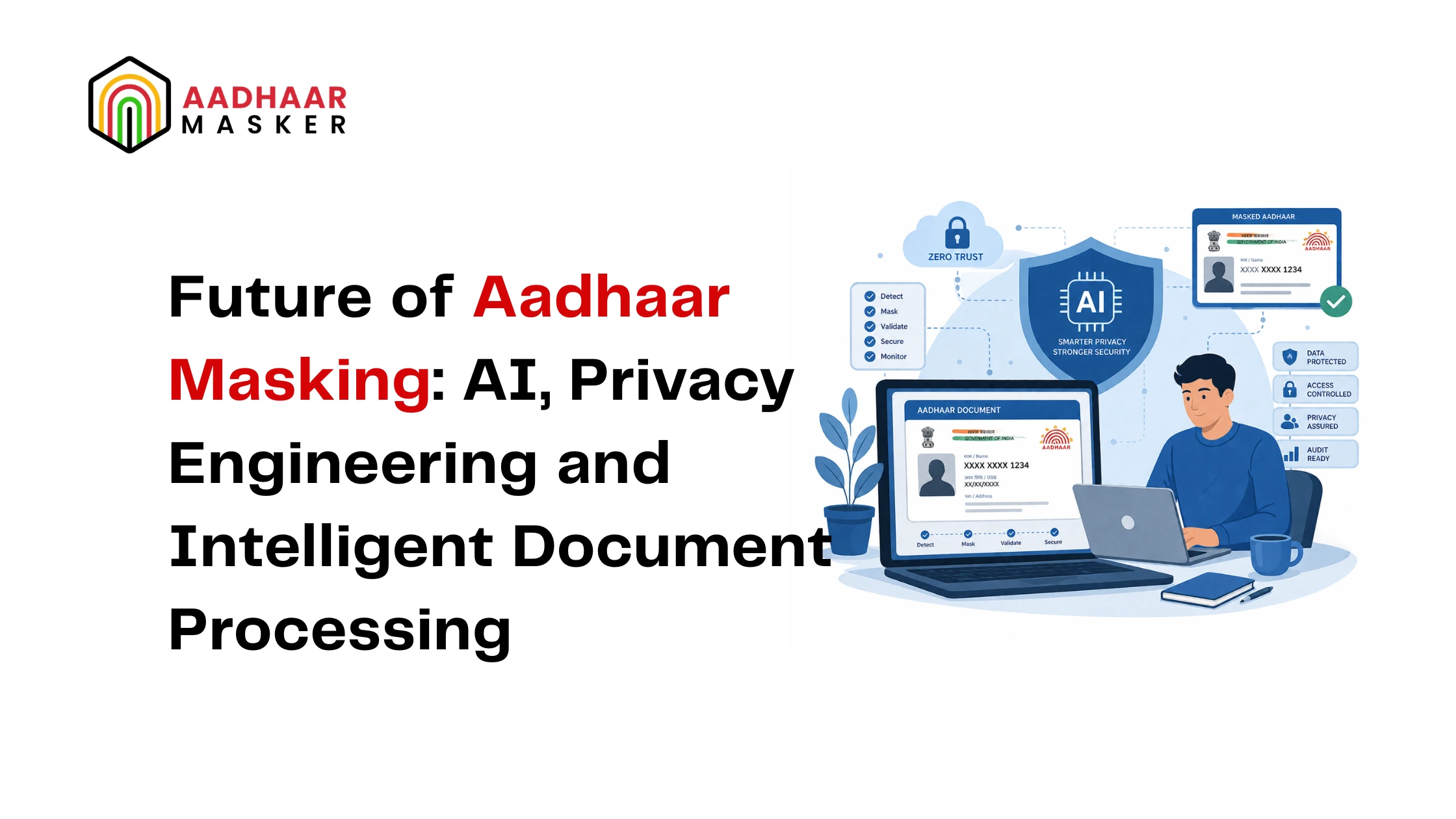
Future-ready Aadhaar masking solutions are designed to protect the entire document lifecycle. They can automatically detect Aadhaar information, understand document context, identify sensitive data, apply masking rules, validate outputs, control access, monitor document usage, and support retention and deletion policies.
To understand the complete enterprise approach to Aadhaar masking, including implementation, security, AI technologies and compliance, explore our Complete Enterprise Guide to Aadhaar Masking.
Why Is Aadhaar Masking Evolving?
Organizations are now processing Aadhaar documents through increasingly complex environments.
Documents are received from multiple sources, including mobile applications, cameras, scanned PDFs, KYC platforms, cloud environments, third-party vendors and enterprise archives. As documents move across different systems, protecting sensitive information throughout the workflow becomes increasingly challenging.
Increasing Document Volumes
Organizations now process thousands or even millions of Aadhaar documents every year. At this scale, manual masking becomes time-consuming, inconsistent and difficult to manage efficiently.
Multiple Document Formats
Aadhaar information is no longer limited to digital PDFs. It can appear in scanned PDFs, JPEG images, PNG files, mobile photographs and photocopies, requiring solutions that can accurately process different document formats.
Increasing Privacy Requirements
Modern privacy programs extend beyond simply masking Aadhaar numbers. Organizations must also consider data minimization, access controls, secure storage, retention policies and auditability throughout the document lifecycle.
Complex Enterprise Workflows
Aadhaar documents often move between multiple departments, business applications and third-party systems. These increasingly connected workflows are driving demand for intelligent Aadhaar masking software that automates privacy protection while integrating with existing enterprise processes.
Future Trends in AI-Powered Aadhaar Masking
1. AI Will Make Aadhaar Detection More Intelligent
The future of Aadhaar masking will move beyond fixed coordinates, templates and simple text matching. AI-powered systems can combine Aadhaar OCR, image processing and document understanding to detect Aadhaar information across rotated, cropped, blurred, low-resolution and differently formatted documents, improving both detection accuracy and masking quality.
2. AI Aadhaar Masking Will Support More Complex Documents
AI Aadhaar masking will increasingly support real-world documents such as mobile photographs, old scans, compressed PDFs and photocopies. By handling variations in lighting, image quality, orientation, resolution and layout, AI-powered masking software can deliver more reliable and scalable Aadhaar privacy protection.
3. Privacy Engineering Will Become a Core Part of Aadhaar Protection
Privacy engineering will make Aadhaar protection part of the entire document lifecycle rather than a standalone masking task. Organizations can build privacy into the way Aadhaar data is collected, processed, stored, accessed, shared and retained, ensuring that only the information required for legitimate business purposes is exposed.
4. Intelligent Document Processing Will Go Beyond OCR
OCR extracts text from documents, but intelligent document processing goes further by understanding document context. By combining OCR, machine learning, computer vision, document classification and business rules, organizations can automatically identify Aadhaar documents, locate sensitive information, apply masking policies and route low-confidence cases for manual review.
5. AI Masking Software Will Support Real-Time Processing
Future AI masking software will enable real-time Aadhaar protection within digital workflows. As soon as a customer uploads a document, the system can automatically detect Aadhaar information, apply masking rules, validate the output and make the protected document available for the next processing stage.
6. Aadhaar Masking Will Become API-Driven
Future Aadhaar masking solutions will increasingly integrate directly with KYC platforms, banking applications, document management systems, CRM platforms, onboarding systems and enterprise archives. API-based integration will automate the complete workflow—from document upload and Aadhaar detection to masking, validation and protected storage—while reducing manual intervention.
7. Privacy Protection Will Become Context-Aware
Future Aadhaar privacy protection will increasingly consider who is accessing a document, why access is required and what information should be visible. This context-aware approach supports data minimization and Zero Trust principles by ensuring users receive only the information necessary for their specific responsibilities.
How Organizations Can Prepare for the Future of Aadhaar Masking
1. Move Beyond Manual Masking
Manual redaction becomes increasingly difficult as document volumes grow. Organizations should adopt automated Aadhaar masking solutions that improve consistency, reduce manual effort and support large-scale document processing.
2. Invest in AI-Powered Detection
Organizations should evaluate AI-powered solutions that can accurately process real-world PDFs, scanned documents and images. Testing with actual business documents helps ensure reliable performance across different document conditions.
3. Build Privacy Into Workflows
Privacy protection should be incorporated during the design of business processes rather than being added later. Embedding Aadhaar masking into document workflows helps reduce unnecessary exposure throughout the document lifecycle.
4. Integrate Masking With Enterprise Systems
Organizations should connect Aadhaar masking with existing KYC platforms, document management systems and onboarding applications using APIs and SDKs. Integration enables automated document protection without disrupting existing workflows.
5. Establish Validation Processes
Automated validation should be combined with human review for low-confidence results or complex documents. This approach improves masking accuracy while maintaining operational efficiency.
6. Monitor the Complete Document Lifecycle
Organizations should monitor how Aadhaar documents are collected, processed, stored, shared, archived and eventually deleted. Managing the complete lifecycle helps strengthen privacy protection and supports better governance.
7. Regularly Review Compliance Requirements
Privacy expectations and regulatory requirements continue to evolve over time. Organizations should periodically review their Aadhaar masking processes and seek appropriate legal or compliance guidance whenever necessary.
Conclusion
The future of Aadhaar masking is moving beyond basic redaction toward intelligent, automated and privacy-focused document protection. AI-powered Aadhaar OCR, document understanding, privacy engineering and intelligent document processing will help organizations detect, mask, validate and manage Aadhaar information across increasingly complex workflows.
The objective is no longer just to hide Aadhaar numbers. The future lies in building an intelligent privacy framework that understands what data exists, who requires access, why it is being processed and how it should be protected.
Future-Proof Your Aadhaar Privacy Workflows with AI
Prepare your organization for the next generation of document security with Pix Dynamics' AI-powered Aadhaar Masking Solution. Automate Aadhaar detection, intelligent masking, and privacy protection across PDFs, scanned documents, and images while seamlessly integrating with your existing KYC and document management systems.
Request a Free Demo and discover how Pix Dynamics helps build intelligent, scalable, and future-ready Aadhaar masking workflows.