
Aadhaar Data Vault Explained: Storage Rules Every Business Should Know
If your business collects Aadhaar numbers for KYC, onboarding, or verification, you are legally required to store them inside an Aadhaar data vault. UIDAI's circular makes this mandatory for any Authentication User Agency (AUA) or e-KYC User Agency (KUA). Yet many organisations — banks, NBFCs, insurers, and fintechs — still store raw Aadhaar numbers in regular databases, often without realising they are out of compliance. This guide explains what an Aadhaar data vault is, how it works, and exactly what the storage rules require.
What Is an Aadhaar Data Vault?
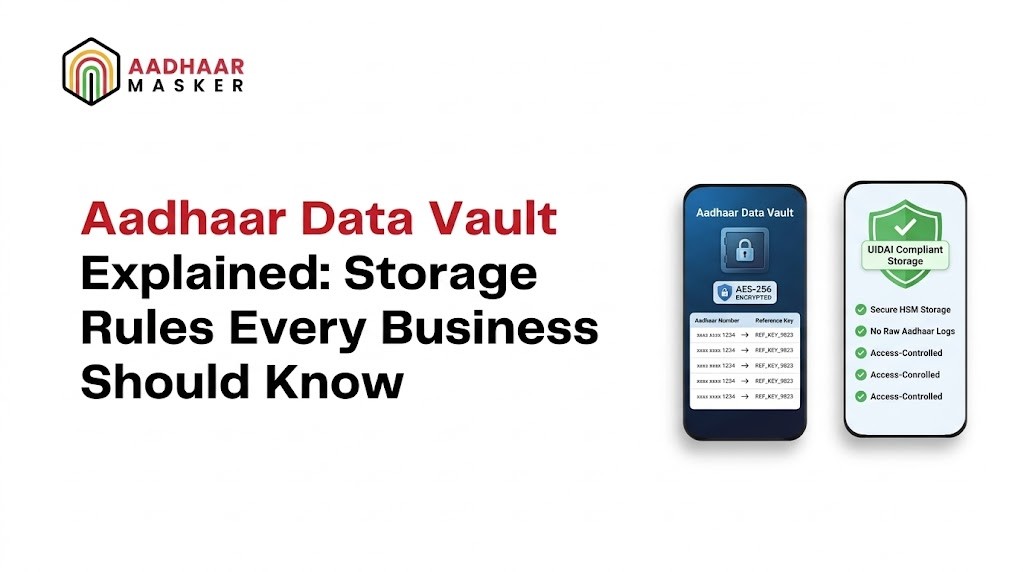
An Aadhaar data vault is a dedicated, encrypted storage system designed exclusively to hold Aadhaar numbers collected by an organisation during authentication or e-KYC processes. Instead of allowing Aadhaar numbers to sit across multiple tables, application databases, or document stores, the vault centralises them in one hardened location and replaces each number in operational systems with a non-reversible reference key.
Think of it as a secure locker that holds the actual Aadhaar numbers, while the rest of your systems only see a surrogate token. Even if an attacker breaches your main database, they cannot retrieve Aadhaar numbers because those numbers are never stored there — only the reference keys are.
UIDAI introduced the data vault mandate through its circular requiring all AUAs and KUAs to comply with a specific set of technical and operational controls. Non-compliance risks suspension of authentication access and regulatory penalties under the Aadhaar Act, 2016.
Why UIDAI Mandated the Aadhaar Data Vault
The data vault requirement exists because Aadhaar numbers are unique, permanent identifiers. Unlike passwords, they cannot be changed if compromised. A single data breach exposing Aadhaar numbers at scale could affect millions of residents permanently, enabling identity fraud, unauthorised authentication, and financial crime.
Before the mandate, many organisations stored Aadhaar numbers the same way they stored any other customer field — in plaintext or with minimal encryption, accessible to any application that needed it. The vault requirement forces organisations to treat Aadhaar numbers differently from all other data: isolated, encrypted, and accessible only through controlled pathways.
For businesses working through their compliance obligations, the Aadhaar masking regulatory checklist covers both vault requirements and the masking controls that sit alongside them — a useful starting point before you audit your current storage practices.
Who Must Use an Aadhaar Data Vault?
The data vault mandate applies to any entity that has been authorised by UIDAI to use Aadhaar-based authentication or e-KYC. This includes:
- Authentication User Agencies (AUAs): Banks, NBFCs, insurers, telecom operators, and government bodies that use Aadhaar authentication to verify customer identity.
- e-KYC User Agencies (KUAs): Entities that use UIDAI's e-KYC service to fetch demographic and biometric data during onboarding.
- Sub-AUAs: Third-party service providers that process authentication requests on behalf of an AUA.
If you are not an AUA or KUA but still collect Aadhaar copies (such as scanned documents during manual KYC), the data vault mandate technically does not cover you — but UIDAI guidelines, the DPDP Act, and sector-specific regulations from RBI, IRDAI, and SEBI still require you to protect Aadhaar numbers stored in any form. The use cases for Aadhaar masking expand well beyond vault-mandated entities.
How Aadhaar Data Vault Works: The Reference Key Model
The core mechanism of the Aadhaar data vault is the reference key. When an Aadhaar number enters your system — through authentication, e-KYC, or document collection — the workflow works as follows:
- The Aadhaar number is sent to the vault, which stores it in encrypted form.
- The vault returns a reference key — a unique, non-reversible token tied to that Aadhaar number within your organisation's system.
- Your applications, databases, and workflows store only the reference key, never the Aadhaar number itself.
- Whenever a process genuinely needs to use the Aadhaar number (for example, to trigger an authentication request), it queries the vault with the reference key to retrieve the number for that operation only — the number is not persisted in the application layer after the operation completes.
This architecture means that a compromise of your customer database, CRM, or document management system exposes only reference keys — meaningless without access to the vault itself, which is separately secured and audited.
Key Storage Rules Every Business Must Follow
UIDAI's data vault guidelines specify both technical requirements and governance controls. Here are the rules that matter most for businesses implementing or auditing their compliance.
1. Aadhaar Numbers Must Be Encrypted at Rest
Aadhaar numbers stored in the vault must use strong encryption — AES-256 is the accepted standard. The encryption keys themselves must be managed separately from the vault data, using a Hardware Security Module (HSM) or equivalent key management system. Storing the encryption key alongside the data it protects defeats the purpose.
2. No Aadhaar Numbers Outside the Vault
Once the vault is operational, no Aadhaar number should appear in any other system — not in application databases, log files, audit trails, email communications, or document storage. Every occurrence of an Aadhaar number outside the vault must be replaced with the reference key. This includes historical records: organisations need to migrate existing stores of Aadhaar numbers into the vault as part of implementation.
3. Access Controls and Audit Logging
Access to the vault must be tightly controlled and logged. Only authorised processes and personnel should be able to retrieve Aadhaar numbers from the vault, and every retrieval must be logged with a timestamp, the requesting process or user, and the purpose. Regular access reviews are required to ensure that permissions have not drifted over time.
4. Network Isolation
The vault should sit on a network segment that is isolated from internet-facing systems. Connections to the vault must go through authenticated, encrypted channels, and inbound access should be limited to specific whitelisted services. Open network paths to the vault are a direct compliance failure.
5. Periodic Security Audits
UIDAI requires AUAs and KUAs to conduct periodic security audits of their Aadhaar data handling, including the vault. These audits must be performed by a CERT-In empanelled auditor and the reports submitted as part of ongoing compliance. Failure to audit is treated the same as a technical failure — both result in non-compliance findings.
6. Data Minimisation and Retention Limits
Aadhaar numbers should not be retained longer than necessary for the purpose for which they were collected. Once a customer relationship ends or a transaction is complete, the Aadhaar number should be purged from the vault (or the reference key deactivated) in accordance with your data retention policy. Indefinite storage without a defined retention rule is a compliance gap.
Where Aadhaar Masking Fits In
The data vault governs how Aadhaar numbers are stored in your backend systems. But Aadhaar masking addresses a different and equally important problem: what happens to the Aadhaar numbers that appear on physical or digital documents — scanned ID copies, KYC uploads, PDF applications — that your organisation receives and stores.
When a customer submits a copy of their Aadhaar card — whether scanned, photographed, or uploaded — the document contains the full 12-digit Aadhaar number. If your organisation stores that document as-is, you are holding an unmasked Aadhaar number outside your vault, in a document management system or file server that almost certainly does not meet vault-level security controls.
Aadhaar masking solves this by automatically detecting and redacting the first 8 digits of the Aadhaar number on every document before it is stored. A masked document — showing only "XXXX-XXXX-1234" — cannot be used to retrieve the full Aadhaar number and therefore does not require vault-level protection for the document store itself.
For organisations processing high volumes of Aadhaar documents, automated AI-based masking integrated into your KYC workflow is the practical way to ensure every incoming document is masked before storage, without creating a manual review bottleneck. This is also one of the controls covered in a thorough Aadhaar masking regulatory checklist.
In short, data vault and masking are complementary controls — not alternatives. The vault protects numbers in your databases; masking protects numbers embedded in documents.
Common Implementation Gaps
Organisations that believe they are compliant often have one or more of these gaps when audited:
- Legacy systems with raw Aadhaar numbers: The vault was implemented for new transactions, but historical records from before the mandate still contain plaintext Aadhaar numbers in old databases or archives.
- Log files: Application logs capture Aadhaar numbers as part of request or response logging, putting them outside the vault in files that may be stored for months or years.
- Document stores with unmasked copies: Thousands of scanned Aadhaar documents sit in document management systems without masking, each one containing a full Aadhaar number.
- Third-party integrations: Aadhaar numbers are passed to vendors or analytics platforms without a reference key conversion, effectively creating an unvaulted copy in a third-party system.
- Missing audit trails: The vault exists but does not log retrievals, or the logs are not reviewed regularly — rendering the access control requirement nominal rather than operational.
A structured audit against the Aadhaar masking regulatory checklist will surface most of these gaps before regulators do.
Penalties for Non-Compliance
UIDAI can suspend or cancel an AUA's or KUA's authentication access for non-compliance with data vault requirements — effectively shutting down any service that depends on Aadhaar-based verification. Beyond UIDAI, the consequences include:
- Aadhaar Act, 2016: Penalties under Section 37 and 38 for unauthorised use or disclosure of Aadhaar data, including imprisonment for officers responsible.
- DPDP Act, 2023: Significant financial penalties for processing personal data without adequate security measures, with Aadhaar numbers classified as sensitive data requiring heightened protection.
- Sector regulators: RBI, IRDAI, and SEBI have their own data security frameworks that incorporate Aadhaar handling requirements. Breaches can trigger enforcement action independently of UIDAI.
The cost of implementing a proper data vault and masking solution is a fraction of the regulatory risk it mitigates.
Steps to Get Your Aadhaar Data Vault Compliance Right
If you are reviewing your current posture or starting from scratch, a practical sequence looks like this:
- Audit existing Aadhaar data holdings: Map every location where Aadhaar numbers currently exist — databases, document stores, log files, backups, and third-party systems.
- Implement or upgrade your vault: Deploy a dedicated encrypted vault with HSM-backed key management and reference key generation for all Aadhaar numbers.
- Migrate historical data: Move existing Aadhaar numbers into the vault and replace them with reference keys in all operational systems.
- Mask all incoming Aadhaar documents: Integrate automated Aadhaar masking into your KYC and document workflows so no unmasked document is stored.
- Establish access controls and logging: Define who and what can access the vault, implement comprehensive audit logging, and set up regular access reviews.
- Schedule periodic audits: Engage a CERT-In empanelled auditor for annual or bi-annual security reviews and maintain the audit reports for submission to UIDAI.
Conclusion
The Aadhaar data vault is not optional for AUAs and KUAs — it is the foundational technical control that UIDAI requires for any entity that handles Aadhaar numbers in digital form. The reference key model it mandates ensures that Aadhaar numbers are never exposed in operational systems, even if those systems are compromised.
For documents, masking picks up where the vault leaves off: ensuring that scanned or uploaded Aadhaar copies never sit in storage with the full 12-digit number visible. Together, these two controls form the backbone of a compliant Aadhaar data handling programme.
If you are not certain whether your current setup meets the requirements, working through a structured Aadhaar masking regulatory checklist is the fastest way to identify gaps before they become a regulatory finding.




Top Posts
- What Is an Aadhaar Data Vault?
- Why UIDAI Mandated the Data Vault
- Who Must Use a Data Vault?
- How the Reference Key Model Works
- Key Storage Rules Businesses Must Follow
- Where Aadhaar Masking Fits In
- Common Implementation Gaps
- Penalties for Non-Compliance
- Steps to Get Compliance Right
- Conclusion