
OCR + Aadhaar Masking: Automating Secure Document Processing
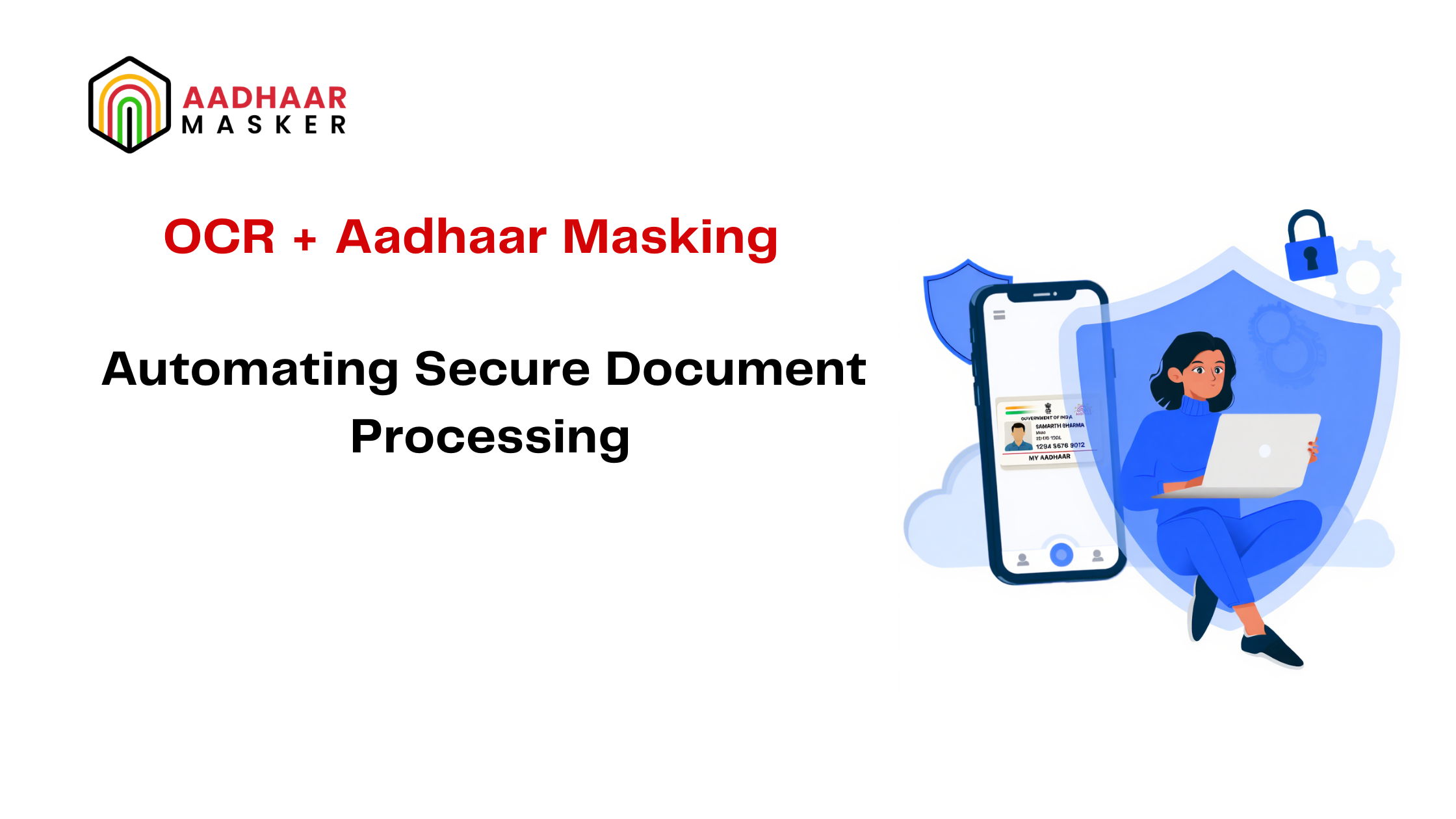
Organizations across banking, fintech, insurance, telecom, healthcare, and government sectors process thousands of Aadhaar documents every day. These documents are often required for customer onboarding, KYC verification, account opening, loan processing, employee verification, and various compliance-related workflows.
However, handling Aadhaar documents comes with an important responsibility—protecting sensitive personal information. Manually reviewing documents and masking Aadhaar numbers is not only time-consuming but also prone to human error.
This is where Aadhaar OCR combined with OCR Aadhaar masking transforms document workflows. By leveraging Artificial Intelligence (AI) and intelligent document processing, organizations can automatically extract Aadhaar data, identify sensitive information, and mask Aadhaar numbers in real time.
In this guide, we'll explore what OCR-based Aadhaar masking is, why organizations are adopting it, and how it enables secure and compliant document processing.
What Is OCR Aadhaar Masking?
OCR Aadhaar masking is the process of automatically detecting Aadhaar numbers within documents and masking sensitive digits before storage, sharing, or further processing.
The process combines:
- *Optical Character Recognition (OCR)
- *Artificial Intelligence (AI)
- *Document classification technologies
- *Automated masking algorithms
Using Aadhaar OCR, organizations can extract text from scanned Aadhaar cards, PDFs, photographs, and digital documents. Once the Aadhaar number is identified, the system automatically masks the first eight digits while retaining only the last four digits when required.
For example:
Original Aadhaar Number:
1234 5678 9012
Masked Aadhaar Number:
XXXX XXXX 9012
This automated approach significantly reduces manual effort while strengthening data privacy.
Why Is OCR Aadhaar Masking Important?
As organizations digitize customer onboarding and KYC processes, document volumes continue to increase. Managing Aadhaar information manually becomes difficult and risky.
Protects Customer Privacy
Aadhaar numbers contain sensitive personal information. Exposing full Aadhaar details unnecessarily increases the risk of misuse, unauthorized access, and identity-related fraud.
Reduces Human Errors
Manual masking often leads to missed Aadhaar numbers or incomplete redaction. Automated OCR Aadhaar masking ensures consistent protection across every document.
Supports Regulatory Compliance
Organizations must follow data protection and privacy best practices when handling customer information. Automated masking helps reduce compliance risks by limiting exposure of sensitive data.
Improves Processing Speed
Instead of manually reviewing documents, teams can process large volumes of Aadhaar files within seconds using AI-powered automation.
Enhances Operational Efficiency
Employees spend less time on repetitive document review tasks and can focus on higher-value business activities.
To gain a deeper understanding of Aadhaar masking, including privacy protection, compliance requirements, secure document sharing, and enterprise implementation strategies, explore our Complete Guide to Aadhaar Masking in 2026: Privacy, Compliance & Secure Document Sharing
Who Benefits From Aadhaar OCR and Automated Masking?
Virtually any organization that handles Aadhaar documents can benefit from OCR-based masking solutions.
Banking and Financial Services
Banks process Aadhaar documents during:
- *Customer onboarding
- *Account opening
- *Loan processing
- *KYC verification
Automated masking protects customer data while accelerating verification workflows.
Insurance Providers
Insurance companies frequently collect Aadhaar documents during policy issuance and claim verification. OCR Aadhaar masking helps secure customer information throughout the process.
Telecom Operators
Telecom providers use Aadhaar for subscriber verification and SIM activation. Automated masking minimizes privacy risks while maintaining efficient onboarding.
Fintech Companies
Digital lenders and fintech platforms often process large volumes of identity documents. AI-driven masking improves scalability and compliance.
Healthcare Organizations
Hospitals and healthcare providers may collect Aadhaar information for patient registration and verification purposes. Automated masking protects sensitive patient records.
Government and Public Sector Agencies
Government departments handling citizen documents can use intelligent document processing to improve security and operational efficiency.
When Should Organizations Use OCR Aadhaar Masking?
Organizations should implement OCR Aadhaar masking whenever Aadhaar documents are:
- *Uploaded through digital onboarding platforms
- *Shared between departments
- *Stored in document repositories
- *Processed during KYC verification
- *Sent to third-party vendors
- *Used for compliance audits
- *Archived for record-keeping purposes
The earlier masking occurs in the document lifecycle, the lower the risk of sensitive data exposure.
Where Is OCR Aadhaar Masking Used?
Modern organizations deploy Aadhaar OCR and masking technology across multiple channels.
Customer Onboarding Platforms
Identity documents are automatically processed as soon as customers upload them.
KYC Verification Systems
OCR engines extract Aadhaar information while masking sensitive details before storage.
Document Management Systems
Archived documents remain protected through automated masking workflows.
Mobile Applications
Customers can upload Aadhaar documents directly from smartphones, where OCR technology processes and masks information instantly.
Enterprise Workflows
Large organizations integrate masking solutions into existing document processing pipelines to ensure consistent privacy protection.
How Does OCR Aadhaar Masking Work?
The process typically involves several automated steps.
Step 1: Document Upload
The system receives an Aadhaar document in the form of:
- *Scanned images
- *PDFs
- *Mobile-captured photos
- *Digital files
Step 2: Aadhaar OCR Extraction
The OCR engine scans the document and extracts text from the image.
This enables accurate identification of:
- *Aadhaar numbers
- *Name
- *Date of birth
- *Address
- *Other identity related information
Step 3: Aadhaar Number Detection
AI algorithms identify Aadhaar patterns and verify whether the detected number matches the Aadhaar format.
Step 4: Automated Masking
The system automatically hides sensitive digits while preserving the required visible information.
Step 5: Secure Output Generation
A masked version of the document is generated for storage, sharing, or downstream processing.
Step 6: Workflow Integration
The processed document can be sent directly into KYC, onboarding, compliance, or document management systems.
The Role of Intelligent Document Processing in Aadhaar Masking
Traditional OCR simply converts images into text. However, modern intelligent document processing goes beyond text extraction.
It uses AI and machine learning to:
- Understand document structure
- Identify document types
- Extract relevant information
- Validate extracted data
- Detect sensitive content
- Automate masking actions
As a result, intelligent document processing delivers greater accuracy, scalability, and automation compared to conventional OCR systems.
Key Benefits of Combining Aadhaar OCR and Automated Masking
Organizations adopting OCR-based masking solutions experience several operational advantages.
Faster Document Processing
Thousands of documents can be processed automatically without manual review.
Improved Accuracy
AI-powered systems reduce errors associated with manual masking.
Enhanced Data Security
Sensitive Aadhaar information remains protected throughout the document lifecycle.
Better Customer Experience
Customers benefit from faster onboarding and verification processes.
Scalable Operations
Organizations can manage growing document volumes without increasing manual workloads.
Stronger Compliance Readiness
Automated controls help support privacy-focused document handling practices.
Organizations adopting Aadhaar masking should also understand how masked documents compare with standard Aadhaar copies. Our Masked Aadhaar vs Regular Aadhaar: Key Differences Explained guide outlines the key privacy, security, and verification differences between the two formats.
Future of Secure Document Processing
As businesses continue to digitize onboarding and identity verification, demand for automated privacy protection will increase. AI-powered Aadhaar OCR, OCR Aadhaar masking, and intelligent document processing technologies are becoming essential tools for organizations seeking to balance operational efficiency with customer data protection.
Future advancements will likely bring:
- Higher OCR accuracy
- Real-time document intelligence
- Automated compliance checks
- AI-driven fraud detection
- End-to-end secure document workflows
Organizations that adopt these technologies today will be better positioned to manage growing document volumes while maintaining strong privacy standards.
Conclusion
Manual Aadhaar document handling is no longer practical for organizations processing large volumes of customer information. By combining Aadhaar OCR, OCR Aadhaar masking, and intelligent document processing, businesses can automate document workflows, improve accuracy, strengthen privacy protection, and support compliance objectives.
As digital onboarding and KYC requirements continue to expand, automated Aadhaar masking is becoming a critical component of secure document processing strategies. Organizations that embrace AI-driven automation can process documents faster, reduce operational risks, and build greater trust with customers through stronger data protection practices.
From KYC verification and customer onboarding to loan processing and compliance workflows, Pixl.ai helps organizations automate Aadhaar OCR and masking in real time. Eliminate manual effort, reduce compliance risks, and process thousands of documents with speed and accuracy.
Schedule a Personalized Demo to explore enterprise-grade Aadhaar masking automation.


Top Posts
- What Is Masked Aadhaar?
- Why Is Masked Aadhaar Important?
- Why Did UIDAI Introduce Masked Aadhaar?
- Is Masked Aadhaar Legally Valid?
- When Should Aadhaar Masking Be Used?
- How Does Aadhaar Masking Improve Privacy and Compliance?
- How Businesses Automate Aadhaar Masking?
- Frequently Asked Questions
- Conclusion
- Protect Aadhaar Data While Simplifying Identity Verification