
Why Manual Aadhaar Redaction Is Risky Compared to AI-Based Masking
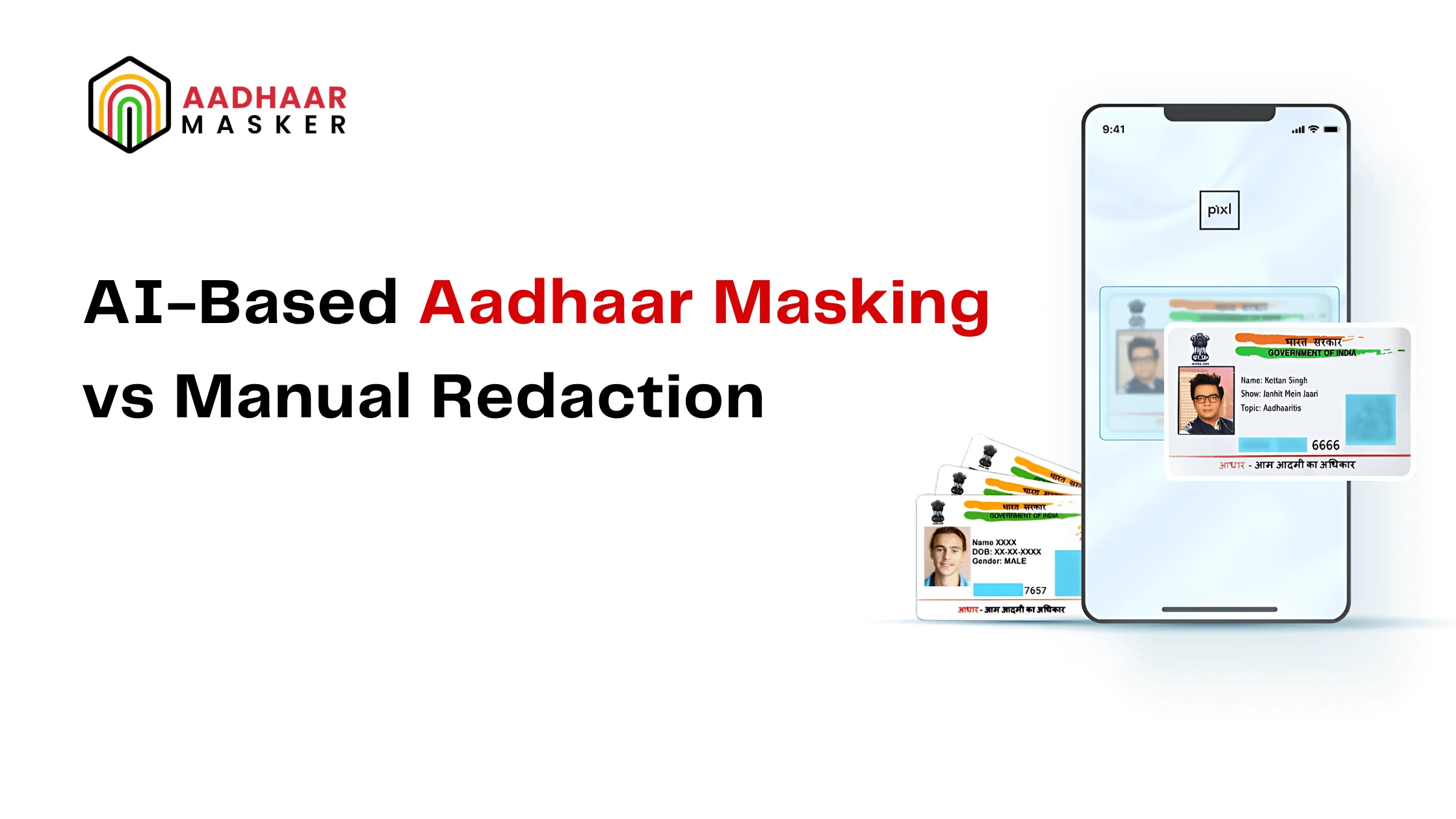
In today's digital-first world, protecting Aadhaar data is just as important as verifying it. Manual redaction may seem like a simple solution, but it often leads to human errors, inconsistent masking, and operational delays. Automated Aadhaar masking enables businesses to secure sensitive information with AI-powered precision, improving Aadhaar privacy protection while making document processing faster and more efficient.
Is manual Aadhaar redaction putting customer data at risk? This guide explores manual vs AI Aadhaar masking, why automation matters, who benefits, when to automate, and how it strengthens Aadhaar privacy protection.
What Is the Difference Between Manual and AI Aadhaar Masking?
Manual vs AI Aadhaar masking refers to two different approaches to protecting Aadhaar information before documents are stored, shared, or processed.
Manual Aadhaar Masking
Manual masking involves employees using editing tools or image software to hide the Aadhaar number before saving or sharing the document.
Common methods include:
- *Drawing black boxes over the Aadhaar number.
- *Editing PDFs manually.
- *Cropping parts of the document.
- *Using image editing software.
While simple, these methods depend entirely on human accuracy.
AI-Based Aadhaar Masking
AI-powered solutions automatically detect Aadhaar documents, identify the Aadhaar number using Optical Character Recognition (OCR), and mask the first eight digits without altering document quality.
This enables automated Aadhaar masking with minimal human intervention.
If you're new to Aadhaar masking, explore our Complete Guide to Aadhaar Masking Software to learn how automated masking works, its business benefits, and how it supports secure document processing across industries.
Why Is Manual Aadhaar Redaction Risky?
Although manual redaction may seem sufficient for low document volumes, it introduces several operational and privacy risks.
Human Error
Employees may forget to mask the Aadhaar number or accidentally leave some digits visible.
Inconsistent Masking
Different teams may follow different masking methods, resulting in inconsistent document protection.
Slow Processing
Manual editing significantly increases processing time during customer onboarding and verification.
Privacy Risks
Unmasked or partially masked Aadhaar numbers can expose sensitive customer information.
Scalability Challenges
Manual processes become difficult to manage as document volumes grow.
These limitations make manual vs AI Aadhaar masking a critical consideration for organizations handling high volumes of identity documents.
Who Should Adopt Automated Aadhaar Masking?
Organizations that frequently process Aadhaar documents benefit the most from automation.
Industries include:
Banking and NBFCs
Customer onboarding, account opening, and loan processing.
Insurance
Policy issuance and claims verification.
Healthcare
Patient registration and insurance documentation.
Fintech
Digital lending and remote KYC.
Telecom
Customer verification and SIM activation.
Government Agencies
Citizen identity verification and public service delivery.
For these sectors, automated Aadhaar masking reduces operational effort while improving Aadhaar privacy protection.
Where Does Manual Masking Usually Fail?
Manual masking often creates challenges across multiple business workflows.
Common areas include:
- *Customer onboarding portals
- *KYC verification systems
- *Loan processing
- *Insurance claims
- *HR onboarding
- *Healthcare registration
- *CRM platforms
- *Shared document repositories
- *Email-based document sharing
Automating these workflows minimizes the risk of accidental exposure.
When Should Businesses Move to AI-Based Aadhaar Masking?
Organizations should consider automation when they experience:
- *Increasing document volumes.
- *Slow manual processing.
- *Frequent masking errors.
- *Multiple document handling teams.
- *Digital customer onboarding.
- *Remote identity verification.
- *Growing privacy and security requirements.
How Does Automated Aadhaar Masking Work?
Modern AI-powered solutions simplify the masking process through automation.
Step 1: Upload the Aadhaar Document
The customer uploads an Aadhaar image or PDF.
Step 2: AI Detects the Document
The system identifies whether the uploaded file contains an Aadhaar card.
Step 3: OCR Extracts the Aadhaar Number
AI accurately identifies the Aadhaar number.
Step 4: Automatic Masking
The first eight digits are hidden while the last four remain visible.
Step 5: Return the Secure Document
The masked document is returned for verification, storage, or further processing.
This process typically completes within seconds and eliminates the need for manual editing.
Want to know how automated masking handles different document formats? Read our guide on how to mask Aadhaar numbers in PDFs, scanned images, and mobile uploads to learn the best practices for secure document processing.
Best Practices for Aadhaar Privacy Protection
To strengthen document security, organizations should:
- *Adopt automated Aadhaar masking instead of manual editing.
- *Mask documents immediately after upload.
- *Encrypt documents during storage and transmission.
- *Restrict access to original Aadhaar documents.
- *Maintain audit logs.
- *Use AI-powered OCR for accurate detection.
- *Integrate masking into onboarding workflows.
- *Regularly monitor document processing accuracy.
Why AI-Based Masking Is the Better Long-Term Solution
To strengthen document security, organizations should:
- *Adopt automated Aadhaar masking instead of manual editing.
- *Mask documents immediately after upload.
- *Encrypt documents during storage and transmission.
- *Restrict access to original Aadhaar documents.
- *Maintain audit logs.
- *Maintain audit logs.
- *Use AI-powered OCR for accurate detection.
- *Integrate masking into onboarding workflows.
- *Regularly monitor document processing accuracy.
Why AI-Based Masking Is the Better Long-Term Solution
As businesses continue to digitize customer onboarding and document verification, manual processes become increasingly difficult to maintain.
AI-powered automated Aadhaar masking enables organizations to:
- *Improve document processing speed.
- *Eliminate repetitive manual work.
- *Strengthen Aadhaar privacy protection.
- *Reduce human error.
- *Scale securely as document volumes grow.
Automation provides a more reliable and efficient approach to protecting customer identity information.
Conclusion
Choosing between manual vs AI Aadhaar masking is no longer just a matter of operational efficiency, it is a key decision for protecting sensitive customer data. Manual redaction is time-consuming, inconsistent, and prone to human error, making it difficult to support modern digital onboarding at scale.
By adopting automated Aadhaar masking, organizations can improve document accuracy, strengthen Aadhaar privacy protection, and create secure, scalable document workflows that enhance both operational efficiency and customer trust.
Switch to AI-Powered Aadhaar Masking Today
Manual Aadhaar redaction slows your workflows and increases the risk of costly errors. Upgrade to automated Aadhaar masking to protect sensitive customer data, improve processing accuracy, and strengthen Aadhaar privacy protection across every document.
- * Eliminate manual errors
- * Automate Aadhaar masking
- *Enhance customer data privacy
- *Scale securely with AI
Book a Free Demo and see how AI-powered Aadhaar masking can transform your document workflows.


Top Posts
- What Is the Difference Between Manual and AI Aadhaar Masking?
- Why Is Manual Aadhaar Redaction Risky?
- Who Should Adopt Automated Aadhaar Masking?
- Where Does Manual Masking Usually Fail?
- When Should Businesses Move to AI-Based Aadhaar Masking?
- How Does Automated Aadhaar Masking Work?
- Best Practices for Aadhaar Privacy Protection
- Why AI-Based Masking Is the Better Long-Term Solution
- Conclusion