
Masking vs Redaction vs Tokenization vs Encryption for Aadhaar Data
Every organisation that handles Aadhaar data reaches a point where it must decide how to protect that data in stored documents, databases, and systems. Four techniques appear in nearly every conversation about Aadhaar data protection: masking, redaction, tokenization, and encryption. Each is a legitimate privacy control. Each solves a different problem. And choosing the wrong one for a given use case creates either a compliance gap or unnecessary operational friction — sometimes both.
The confusion is understandable. The terms are often used loosely in vendor materials and regulatory guidance alike. Aadhaar masking vs tokenization is one of the most common points of confusion, because both techniques can be described as "replacing" the Aadhaar number with something else — but what they replace it with, why they do so, and what the result enables are fundamentally different. This guide compares all four controls side by side, explains the mechanics of each, and maps each technique to the use cases where it genuinely fits.
The Four Controls: A Plain-Language Overview
Before comparing them, it helps to establish what each technique actually does at the data level.
Masking
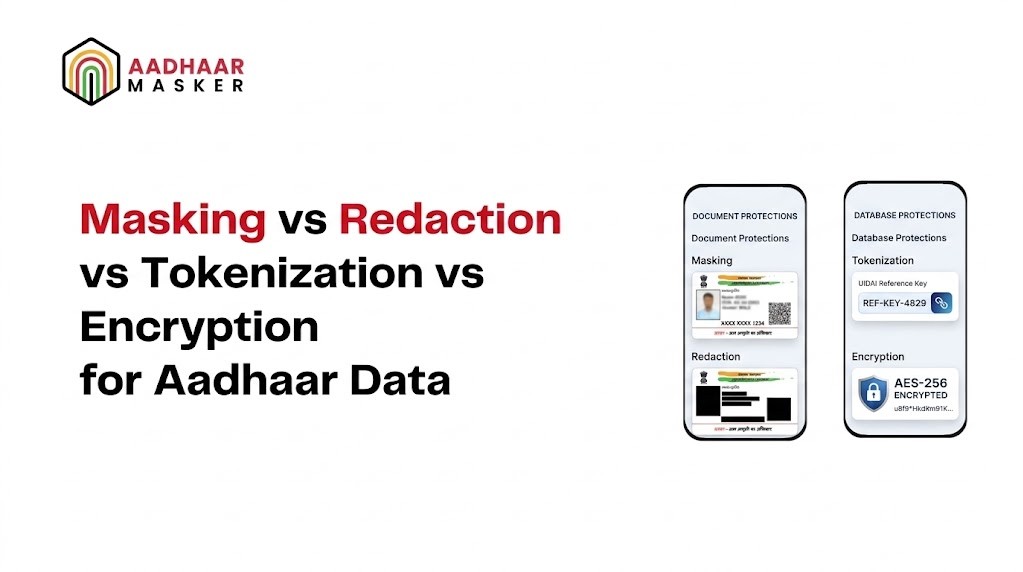
Aadhaar masking replaces part of the Aadhaar number with placeholder characters — most commonly the first eight digits replaced with X's, leaving only the last four digits visible. The result is a document or record that shows "XXXX-XXXX-3456" instead of the full number. The original number is not stored alongside the masked version; it is simply absent from the stored document. Masking is a one-way operation on the document layer — once applied, the full number cannot be recovered from the masked output alone.
Redaction
Redaction goes further than masking: it removes the sensitive information entirely, replacing it with a blank space, a solid block, or the word "REDACTED." While masking preserves partial information (the last four digits), redaction removes all of it. On a physical or scanned document, redaction typically means blacking out the entire Aadhaar number field. On a database record, it means deleting the field value or replacing it with a null. Like masking, redaction is irreversible by design.
Tokenization
Tokenization replaces the Aadhaar number with a surrogate value — a token — that has no mathematical relationship to the original number. The token looks like a random identifier. The mapping between the token and the original Aadhaar number is stored separately in a secure token vault. Systems that need to process the Aadhaar number use the token instead; only authorised systems with access to the vault can resolve the token back to the original. This is a reversible operation for authorised parties and irreversible for everyone else.
Encryption
Encryption transforms the Aadhaar number into ciphertext using a cryptographic key. Anyone with the decryption key can recover the original number exactly. Encryption is fully reversible for key holders and computationally irreversible for everyone else. The encrypted value is typically stored alongside the record it protects; the key is stored and managed separately.
How the Four Techniques Compare
The table below summarises the key attributes of each control across dimensions that matter for Aadhaar data handling:
| Attribute | Masking | Redaction | Tokenization | Encryption |
|---|---|---|---|---|
| Original data recoverable? | No | No | Yes (vault access) | Yes (key access) |
| Partial data retained? | Yes (last 4 digits) | No | No | No (ciphertext only) |
| Works on documents? | Yes | Yes | No (database layer) | Partial (field-level) |
| Works in databases? | Yes | Yes | Yes | Yes |
| Supports downstream processing? | Limited | No | Yes | Only after decryption |
| Regulatory alignment (UIDAI) | Direct — UIDAI defines this | Acceptable for storage | Required for data vaults | Complementary control |
| Complexity to implement | Low–Medium | Low | High | Medium–High |
Aadhaar Masking: What It Is For and What It Is Not
UIDAI introduced the concept of masked Aadhaar specifically to address a practical problem: organisations needed to share or store some evidence that a person had presented their Aadhaar for verification, without retaining the full 12-digit number. The masked Aadhaar — showing only the last four digits — is the UIDAI-defined format for this purpose. It is valid for identity verification in contexts where presenting the full number is not required.
Masking operates at the document layer. When a scanned Aadhaar card is processed through a masking system, the printed number on the image is overwritten with X characters, and the QR code is redacted, so that neither the human-readable nor the machine-readable version of the full number remains on the stored document. The stored copy proves that an Aadhaar card was presented and identifies the cardholder by the last four digits — enough for audit purposes, insufficient for identity fraud.
For a deeper look at how Aadhaar masking vs data masking differ as concepts — since general data masking in databases is a related but distinct practice — that distinction matters when choosing controls for document workflows versus database records.
What masking is not: it is not a technique for databases that need to process or look up Aadhaar numbers. Once a document is masked, the full number is gone. If downstream systems need to verify, cross-reference, or authenticate using the Aadhaar number, masking alone is insufficient. Those use cases require tokenization or encryption applied at the database layer before masking happens at the document layer.
Redaction: Complete Removal for Permanent Records
Redaction is the most absolute of the four controls. It removes the sensitive data entirely, leaving no partial identifier. On a physical or scanned document, this means blacking out the Aadhaar number field completely — no digits visible, no QR code readable. On a database record, it means deleting the field value permanently.
Redaction fits use cases where no information from the Aadhaar number field is needed in the stored copy at all. An audit log that needs to record only that identity was verified — without retaining any portion of the Aadhaar number — is a candidate for redaction. Long-term archival documents where the retention period for Aadhaar data has expired are another: the document can remain in the archive as evidence that the transaction occurred, with the Aadhaar field permanently redacted.
The limitation of redaction is that it destroys utility along with the sensitive data. If your use case requires even the last four digits to be present — for customer service identification, for audit trail matching, or for regulatory reporting — redaction removes too much. In those scenarios, masking is the appropriate control.
One important technical point: on scanned documents stored as PDFs, true redaction requires burning the black-out into the image at the pixel level. A PDF annotation layer that draws a black rectangle over the field looks redacted on screen but leaves the underlying text or image data accessible in the PDF content stream. Genuine redaction removes the data from the document object, not just from the visible layer.
Tokenization: The Right Control for Operational Databases
When the comparison is aadhaar masking vs tokenization, the key distinction is reversibility combined with use case. Masking serves document storage; tokenization serves operational databases that need to process Aadhaar numbers as part of ongoing workflows.
Tokenization replaces the Aadhaar number with a random surrogate value — a token — that is stored in the operational database. The mapping between the token and the original Aadhaar number is held in a separate, highly secured token vault. Systems that need to perform identity verification, de-duplication, or cross-referencing can do so using the token: they query the vault with the token, receive the original number, perform the necessary operation, and discard the decrypted value without persisting it. The operational database never stores the actual Aadhaar number.
UIDAI's regulations on Aadhaar data vaults make tokenization not just a best practice but a regulatory requirement for certain categories of entities. Any organisation that is an Authentication User Agency (AUA) or e-KYC User Agency (KUA) and needs to reference Aadhaar numbers in its systems must implement a data vault that tokenizes the numbers before storing them. The vault itself — not the operational database — holds the protected data, under strict access controls.
The complexity cost of tokenization is real. Implementing a compliant token vault requires a separate, hardened infrastructure component, access control policies, key management for the vault itself, and careful API design so that operational systems never handle raw Aadhaar numbers. But this complexity is the point: the architecture physically separates the sensitive identifier from the operational systems that process it, reducing the blast radius of a breach in any single system.
Encryption: A Transport and Storage Layer Control
Encryption is frequently conflated with the other three techniques because it also "protects" the Aadhaar number. The difference is that encryption is a reversible transformation for key holders, making it a different category of control entirely.
Encryption is the right choice when the Aadhaar number must be transmitted across a network — between an organisation's internal systems, between an organisation and UIDAI authentication services, or between business partners — and the data in transit must be protected against interception. TLS encryption at the transport layer protects Aadhaar numbers during transmission. Field-level or database encryption protects the stored value against direct database access.
The critical limitation of encryption as a primary data protection control is key management. If the encryption key is compromised, every encrypted Aadhaar number it protects becomes recoverable. A key breach is not a breach of one record — it is a breach of the entire encrypted dataset. This is why encryption is typically used as a complementary control rather than a primary one: it protects the data in transit and at rest, but it does not replace the need for masking on documents or tokenization in operational databases.
Encryption is also insufficient for document storage on its own. Encrypting a scanned Aadhaar card image protects the file from external access, but the moment an authorised system decrypts it for display or processing, the full number becomes visible. Masking must have been applied to the document before encryption for the stored image to be genuinely protected.
Matching the Control to the Use Case
The practical question for most organisations is not which technique is "best" in the abstract, but which technique fits each specific use case. The answer is almost always a combination of controls applied at different layers.
Incoming document at onboarding
When a customer submits an Aadhaar document — scanned, photographed, or uploaded as a PDF — the first action should be masking. Apply AI-based masking to obscure the printed number and redact the QR code before the document reaches your storage layer. What goes into storage is the masked image, not the original. This is the UIDAI-aligned approach for document retention.
Aadhaar number in an operational database
If your system needs to store the Aadhaar number for authentication, de-duplication, or cross-referencing, tokenization is the correct control. Replace the Aadhaar number with a token in your operational database and store the mapping in a compliant token vault. Operational systems use the token; only the vault holds the original, under strict access controls.
Aadhaar number in transit
When the Aadhaar number must travel across a network — to UIDAI authentication services, to a partner system, or between your own microservices — encryption in transit is mandatory. TLS at the transport layer is the baseline. Field-level encryption for particularly sensitive API payloads adds an additional layer.
Long-term archival records
For documents held beyond their active use period, where the Aadhaar number has no further operational purpose, redaction is appropriate. Replace the number field entirely in the archived copy, retaining the document as evidence of the transaction without retaining the identifier itself. This directly satisfies the data minimisation requirements of the Digital Personal Data Protection Act, 2023.
Analytics and reporting
For datasets used in analytics, risk modelling, or internal reporting where individual Aadhaar numbers are not needed, data masking at the database level — replacing values with synthetic substitutes — protects the data while preserving the statistical properties needed for analysis. This is general data masking applied to a database export, distinct from the document-level masking described above.
Where Organisations Go Wrong: The Most Common Mismatches
Understanding the four controls in theory is useful; recognising the mismatches that lead to compliance gaps is more practical.
Using encryption as a substitute for masking on documents
Encrypting a scanned Aadhaar card image is not the same as masking it. The image still contains the full number — it is just inaccessible without the key. If the key is compromised, or if the image is decrypted for authorised use and the full-resolution copy is then stored unmasked, the protection evaporates. Masking must be applied to the document content before the file is stored, regardless of whether the file is also encrypted.
Treating masking as sufficient for database records
Some organisations apply document-style masking to database fields — storing "XXXX-XXXX-3456" as a text string in the customer record. This is appropriate for an audit trail field but not for a field that needs to support identity verification or de-duplication. A masked string cannot be used to authenticate a returning customer or to check whether a new application is a duplicate. Those use cases require the original number to be accessible through a controlled mechanism — which means tokenization, not masking.
Implementing tokenization without masking incoming documents
A compliant token vault is valuable, but it does not protect the documents in your storage layer. If your system tokenizes the Aadhaar number in the database but stores the original scanned document without masking, the full number is accessible from the document store. Both layers must be addressed independently.
Relying on access controls in place of data controls
Access controls — role-based permissions, authentication, audit logging — are important but they are not data controls. A database field that contains an unmasked, un-tokenized Aadhaar number is exposed to anyone who gains access to that database, whether through legitimate credentials, a breach, or an insider threat. Data controls make the data itself useless to an unauthorised party; access controls reduce the probability that an unauthorised party reaches the data. Both are needed.
Regulatory Framing: What Indian Law Requires
Indian regulations do not mandate a single technique for Aadhaar data protection, but they do establish requirements that point clearly toward specific controls in specific contexts.
The Aadhaar (Targeted Delivery of Financial and Other Subsidies, Benefits and Services) Act, 2016 and the associated UIDAI regulations establish that entities handling Aadhaar data must protect it with security measures commensurate with its sensitivity. UIDAI's specific guidance on masked Aadhaar defines the document-layer masking standard. UIDAI's data vault requirements define the database-layer tokenization standard for regulated entities.
The Digital Personal Data Protection Act, 2023 adds a data minimisation principle: personal data collected must be limited to what is necessary for the stated purpose. This principle directly supports both masking (retain only the last four digits, not the full number) and redaction (remove the number entirely when the retention period has expired). It also supports tokenization: operational systems should not have access to the full Aadhaar number if a token is sufficient for their function.
Sector regulators — RBI for banking, IRDAI for insurance, SEBI for securities — add their own guidance on data protection that generally reinforces these principles while adding sector-specific requirements around audit trails, access controls, and breach notification.
Choosing the Right Control: A Decision Framework
The following questions lead most organisations to the right combination of controls:
- Is the Aadhaar data in a document or a database field? Documents need masking (and redaction of QR codes). Database fields need tokenization or masking depending on whether the value needs to be recoverable.
- Does any downstream system need to recover the original Aadhaar number? If yes, tokenization is required — masking and redaction are both irreversible. If no, masking or redaction is sufficient.
- How long will this data be retained? For active records, masking preserves the last four digits for audit purposes. For long-term archives where no operational use remains, redaction removes even that residual data.
- Is the Aadhaar number being transmitted? If yes, encryption in transit is required alongside whatever at-rest control is applied.
- Are you a UIDAI-regulated entity (AUA/KUA)? If yes, a compliant data vault with tokenization is a regulatory requirement, not a choice.
For most organisations — financial services, insurance, healthcare, telecom, and any business that onboards customers using Aadhaar — the answer is a layered approach: masking on documents at ingestion, tokenization in the operational database, and encryption in transit. These three controls applied together address document storage, database storage, and data movement with appropriate techniques at each layer.
Conclusion
Masking, redaction, tokenization, and encryption are not competing solutions to the same problem — they are complementary controls that address different aspects of Aadhaar data protection at different layers of your system. Choosing between them is not an either/or decision; it is a question of which control applies at which layer for which purpose.
Aadhaar masking vs tokenization is perhaps the most important comparison to understand clearly: masking protects documents by making the number non-recoverable, while tokenization protects database records by making the number recoverable only through a secured vault. Both are needed in any system that handles scanned Aadhaar documents alongside operational identity data. Redaction extends masking to cases where even the last four digits should not be retained. Encryption protects data in transit and at rest, but as a complement to — not a replacement for — the other controls.
Organisations that understand this layered approach are better positioned to implement controls that genuinely satisfy UIDAI requirements, DPDP Act obligations, and sector-specific regulatory expectations — rather than controls that look complete on paper but leave gaps at one layer or another. The starting point for most organisations is getting document-layer masking right, because it is the control that governs the largest volume of incoming Aadhaar data and the one most directly addressed by UIDAI's own guidance on masked Aadhaar.



Top Posts
- The Four Controls: A Plain-Language Overview
- How the Four Techniques Compare
- Aadhaar Masking: What It Is For
- Redaction: Complete Removal
- Tokenization: The Right Control for Databases
- Encryption: Transport and Storage Layer
- Matching the Control to the Use Case
- Where Organisations Go Wrong
- Regulatory Framing
- A Decision Framework
- Conclusion