
Build vs Buy: Aadhaar Masking Software for Enterprises (Cost, Time and Risk)
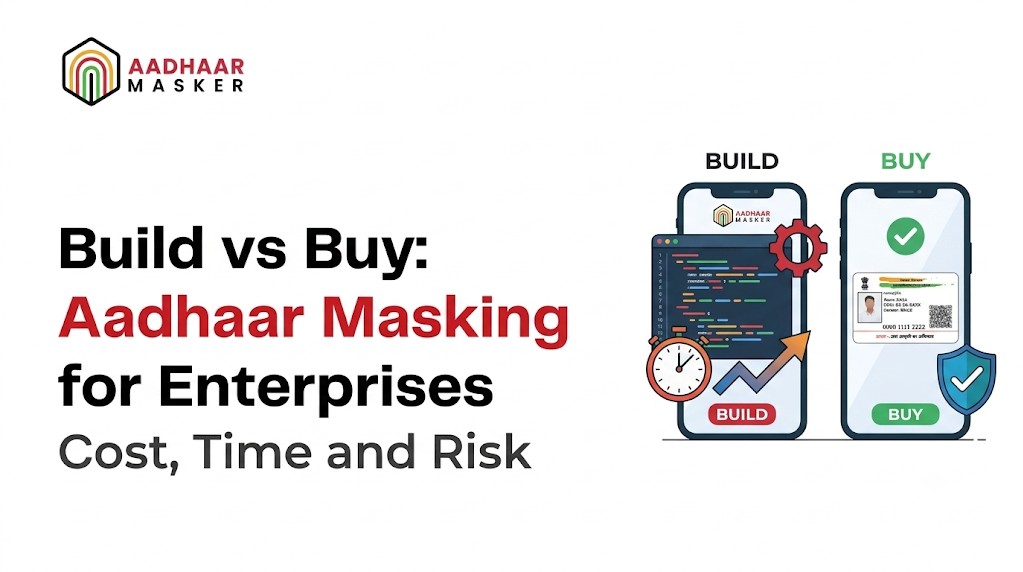
Every enterprise that handles Aadhaar documents eventually faces the same question: should the engineering team build an in-house masking engine, or should the organization adopt a proven Aadhaar Masking API from a specialist vendor? On the surface, masking looks simple: find the first eight digits of a twelve-digit number and cover them. In practice, the gap between a working prototype and a production-grade, auditable aadhar masking solution is wide, expensive and full of compliance risk.
This blog breaks down the aadhaar masking software build vs buy decision across the four dimensions that matter most to enterprise leaders: cost, time to production, accuracy and regulatory risk. It is written for CTOs, compliance heads and procurement teams who need a clear-eyed comparison before committing budget and engineering capacity.
Why the Build vs Buy Question Matters Now
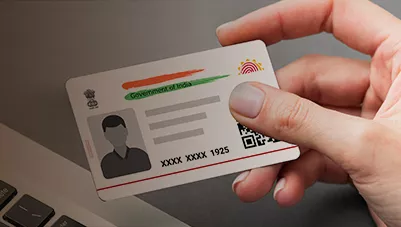
UIDAI regulations require that organizations storing physical or digital copies of Aadhaar documents mask the first eight digits of the Aadhaar number and ensure that the QR code cannot be used to retrieve the full number. The Digital Personal Data Protection Act adds accountability obligations on top of this, meaning organizations must not only mask but also prove that masking happened consistently.
As document volumes grow across onboarding, lending, HR and vendor management, manual masking stops being viable. Enterprises then have two paths: invest engineering effort in a custom pipeline, or integrate a ready-made masking service. The right choice depends less on technical ability, since most enterprise teams can build something, and more on whether building it is the best use of time, money and risk appetite.
What Building Aadhaar Masking Actually Involves
A prototype that masks clean, well-aligned scans of Aadhaar cards can be assembled in a few weeks using open-source OCR. A production system is a different undertaking. An in-house build typically needs:
- Document classification to identify Aadhaar cards, e-Aadhaar PDFs and mAadhaar screenshots among mixed uploads
- OCR and number detection that works on blurred, rotated, low-light and partially cropped images
- Validation logic (including Verhoeff checksum checks) to separate real Aadhaar numbers from look-alike digit strings
- QR code detection and neutralization on both front and back sides of the card
- Handling of regional-language layouts, old and new card designs, and printed letters
- Confidence scoring, exception routing and a human review queue
- Audit logging, access control and secure storage of originals during processing
- Scaling infrastructure for batch jobs and real-time API traffic
Each of these is a sub-project. Together they represent a long-lived product that must be maintained, retrained and re-certified as document formats and regulations change.
Cost Comparison: Build vs Buy
Cost is usually where the decision starts, and it is also where in-house estimates are most often wrong. The visible cost of building is engineering salaries during development. The real cost includes everything that comes after go-live.
The Cost of Building In-House
A realistic in-house team for a production masking engine includes machine learning or computer vision engineers, backend developers, a QA engineer with access to a large and diverse test set, DevOps support and part-time security and compliance review. Even a lean team spends several months reaching production quality, and the ongoing maintenance load (model retraining, bug fixes for new document variants, infrastructure upkeep and security patching) does not end after launch.
Hidden costs add up quickly:
- Collecting and labelling training data containing Aadhaar numbers, which itself creates a sensitive data-handling obligation
- GPU or high-CPU infrastructure for OCR and detection at scale
- Internal and external security audits of the new system
- Opportunity cost of engineers not working on core product features
- Knowledge risk when the original developers leave the organization
The Cost of Buying
Buying converts most of these costs into a predictable, usage-based or subscription fee. Integration work is typically limited to calling an API, handling responses and wiring the output into existing storage. For organizations processing large document backlogs or high monthly volumes, it is worth reviewing the bulk Aadhaar masking cost to model total spend against expected volume. In most scenarios, the per-document price of a specialist service is a fraction of the fully loaded cost of running an internal engine.
Total Cost of Ownership Over Three Years
The most useful comparison is a three-year total cost of ownership. Build costs are front-loaded and then continue as maintenance; buy costs scale with usage but carry almost no fixed overhead. Unless an organization has extremely high volumes, a dedicated computer vision team already in place and a strategic reason to own the IP, buying almost always wins on TCO.
Time to Production
Compliance deadlines rarely wait for engineering roadmaps. An in-house build commonly takes six to twelve months to move from proof of concept to a hardened, audited production system, and longer if the team must first source and label a representative document dataset.
An established Aadhaar Masking API can often be integrated and tested within days or a few weeks. The vendor has already solved document variety, QR handling and scaling, so the enterprise team focuses only on integration, testing against its own sample documents and updating internal workflows.
Every month spent building is a month in which unmasked Aadhaar copies continue to accumulate in storage systems, inboxes and shared drives. That backlog becomes a liability of its own and later has to be cleaned up through retrospective masking.
Accuracy: The Hardest Part to Get Right
A masking system is only as good as its worst miss. A single unmasked Aadhaar number in a stored document is a compliance failure, regardless of how many thousands were masked correctly. This makes false negatives, meaning Aadhaar numbers the system fails to detect, the most important accuracy metric.
In-house systems tend to perform well on the clean samples used during development and then degrade on real-world inputs: photos taken at an angle, documents with stamps or signatures over the digits, low-resolution WhatsApp forwards and multi-page PDFs where the Aadhaar appears on page four. Specialist vendors have typically trained and tested on far larger and more varied document sets, and they continuously improve their models as new failure patterns surface across many customers.
Before deciding, enterprises should benchmark any option, built or bought, on their own document sample, measuring detection recall, QR masking rate and the share of documents routed to manual review.
Compliance and Security Risk
Risk is where the build vs buy decision has the longest tail. When an organization builds its own masking engine, it owns every compliance outcome: missed numbers, unmasked QR codes, insecure temporary storage of originals and gaps in audit logs. There is no external party with specialist accountability.
A mature aadhar masking solution brings controls that are difficult to replicate quickly:
- Built-in QR code masking alongside number masking
- Structured audit logs with per-document outcomes and confidence scores
- Encryption in transit and at rest, with no persistent storage of original documents
- On-premise or private cloud deployment options for regulated sectors
- Documentation that supports internal audits and DPDP readiness reviews
Buying does not remove accountability, as the enterprise remains the data fiduciary, but it shifts much of the technical risk to a provider whose core business is getting masking right.
Masking vs Verification: Do Not Confuse the Two
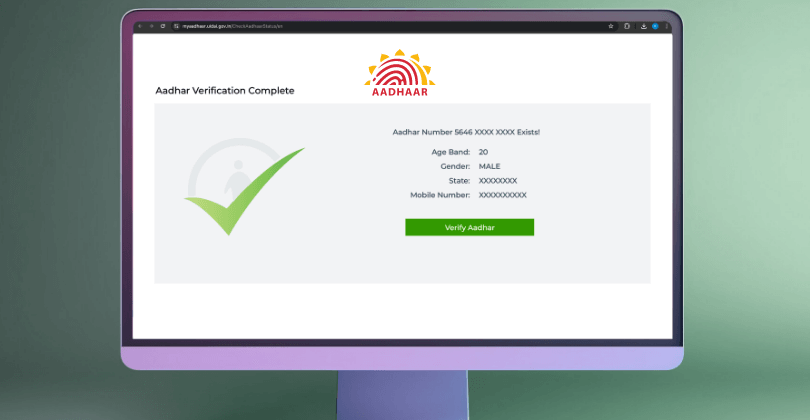
Teams evaluating options sometimes assume that an aadhaar verification api already covers masking. It does not. Verification confirms that an Aadhaar number is valid or that a person's details match UIDAI records. Masking protects the document copies that remain in your systems after verification is complete.
Most enterprises need both: verification at the point of onboarding, and masking for every Aadhaar image or PDF that is stored, shared or forwarded afterwards. When comparing vendors, check whether the masking service integrates cleanly with your existing verification and KYC stack, so that documents move from verification to masking to storage without manual handling in between.
When Building In-House Can Make Sense
Building is not always the wrong answer. It can be justified when:
- The organization already runs a mature document AI team with labelled Aadhaar datasets
- Masking is deeply embedded in a proprietary product that the company sells to others
- Volumes are so large that per-document pricing exceeds the cost of a dedicated team
- Policy forbids any third-party processing and no vendor offers an on-premise deployment
Even in these cases, many enterprises choose a hybrid approach: deploy a vendor's engine on-premise and build only the surrounding workflow, storage and review tooling in-house.
A Simple Decision Framework
Use these questions to guide the aadhaar masking software build vs buy decision:
- Deadline: Do you need compliant masking within the next quarter? If yes, buy.
- Capability: Do you have an existing computer vision team with spare capacity? If not, buy.
- Volume: Have you modelled three-year TCO against vendor pricing at your expected volume?
- Accuracy: Can an in-house system match vendor recall on your real-world documents, including QR codes?
- Risk: Who will be accountable for missed numbers, audit logs and security reviews?
- Deployment: Does a vendor offer cloud, private cloud or on-premise options that meet your data residency rules?
If most answers point to speed, predictable cost and reduced risk, buying a specialist service is the stronger choice.
Conclusion
Building Aadhaar masking in-house looks cheaper on a whiteboard and becomes more expensive in production. The true costs of dataset creation, edge-case accuracy, QR handling, audit logging, security reviews and long-term maintenance accumulate long after the first release. Meanwhile, every month of delay leaves unmasked Aadhaar copies exposed.
For most enterprises, a proven Aadhaar Masking API delivers faster compliance, more predictable cost and lower risk, freeing engineering teams to focus on the products that differentiate the business. Build only when you have a clear strategic reason, the right team and the volume to justify it.
Skip the Build. Get Compliant Faster.
Our Aadhaar masking platform gives enterprises production-ready masking from day one, with accurate number and QR code masking, bulk and real-time processing, and complete audit logs, through a simple API or on-premise deployment.
- High-accuracy detection across scans, photos, PDFs and mAadhaar screenshots
- Automatic QR code masking on every document
- Bulk processing for historical backlogs and real-time API for new uploads
- Cloud, private cloud and on-premise deployment options
Request a Personalized Demo to compare the cost and timeline of our solution against an in-house build for your document volumes.


Top Posts
- Why the Build vs Buy Question Matters Now
- What Building Aadhaar Masking Actually Involves
- Cost Comparison: Build vs Buy
- Time to Production
- Accuracy: The Hardest Part to Get Right
- Compliance and Security Risk
- Masking vs Verification: Do Not Confuse the Two
- When Building In-House Can Make Sense
- A Simple Decision Framework
- Conclusion